October 28, 2026

Content Marketing

The Ultimate Content Audit Guide

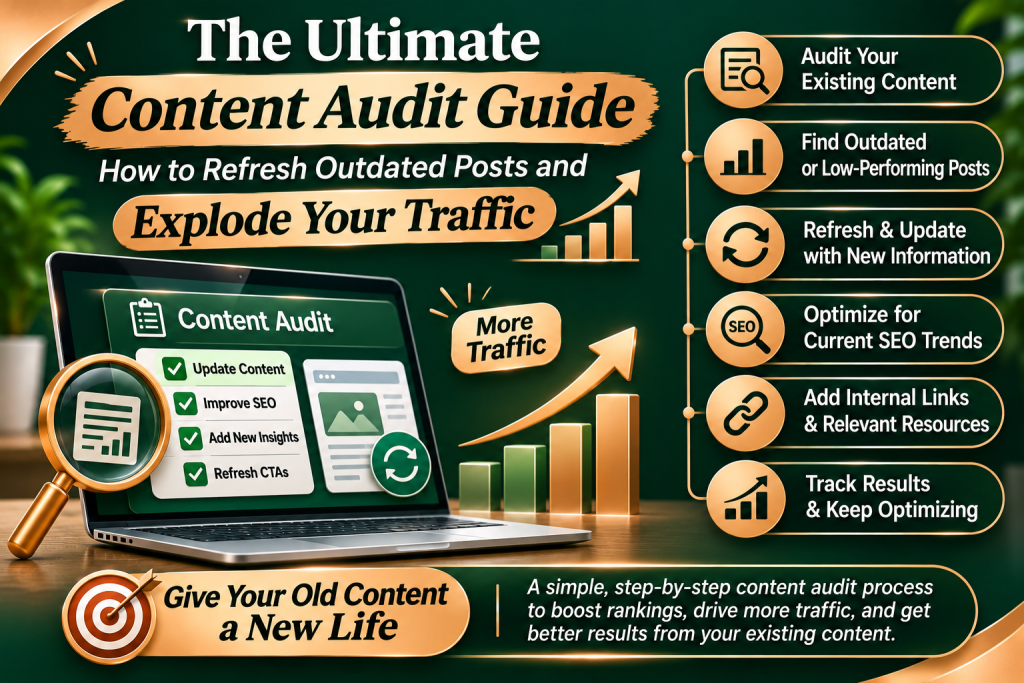
The Ultimate Content Audit Guide The Ultimate Content Audit Guide: How to Refresh Outdated Posts and Explode Your Traffic Imagine spending months writing high-quality blog posts, only to watch your organic traffic slowly decline over time. You keep publishing new articles, but your overall Google rankings remain stagnant. If this sounds familiar, you do not necessarily have a content creation problem—you have a content maintenance problem.Many website owners believe that the secret to SEO success is continuously publishing new content. However, the internet is cluttered with outdated, thin, and duplicate pages. Google prioritizes websites that maintain a clean, highly relevant, and accurate index of information.This is where a content audit comes in. By systematically reviewing your existing content assets, you can find hidden opportunities to regain lost traffic, delete dead weight, and maximize your search engine visibility. In this ultimate guide, we will walk you through a step-by-step framework to audit your content like a seasoned SEO professional. What is a Content Audits and Why Does Your Website Need One? A content audit is the process of collecting, analyzing, and evaluating all the content currently live on your website. Think of it as a routine health checkup for your blog. Instead of guessing which pages are performing well, an audit gives you hard, data-driven insights. As your website grows, several issues naturally occur over time: • Content Decay: Information changes, statistics get outdated, and once-trending topics lose search volume.• Keyword Cannibalization: You accidentally write multiple articles targeting the exact same keyword, causing Google to get confused and rank none of them highly.• Technical Debt: Broken links accumulate, images fail to load, and older pages suffer from poor mobile optimization. By executing a regular content audit, you achieve three critical business goals: • Improve Search Engine Rankings: Cleaning up low-quality pages tells Google that your entire website is authoritative and trustworthy.• Enhance User Experience (UX): Visitors stay longer on your website when they find accurate, updated, and highly structured information.• Optimize Conversion Rates: Updating old call-to-actions (CTAs) directs existing traffic toward your latest products, services, or lead magnets. Phase 1: Preparation and Data Gathering You cannot audit what you cannot see. The first phase of a successful content audit involves crawling your website and aggregating data into a single master spreadsheet. 1. Crawl Your Website URL Structure To begin, you need a complete list of all live URLs on your website. You can use industry-standard tools like Screaming Frog SEO Spider, Ahrefs, or Semrush to crawl your domain. Export this data into a Google Sheet or Microsoft Excel file.  2. Connect Your Analytics Tools To accurately evaluate your pages, you must pull performance metrics from the past 12 months. Ensure your spreadsheet includes columns for data pulled from:• Google Search Console (GSC): Gather impressions, organic clicks, average position, and target keywords.• Google Analytics 4 (GA4): Track page views, average engagement time, bounce rates, and conversion numbers.• Backlink Analysis Tools: Note the number of referring domains and the URL Rating (UR) or Page Authority (PA) of each link.  3. Build Your Inventory DashboardYour final master spreadsheet should display the following columns for every single URL:• Page Title & URL• Target Primary Keyword• Organic Clicks (Past 12 Months)• Page Views & Engagement Rate• Total Number of Backlinks• Publication Date & Last Updated Da Phase 2: Evaluating Your Content Performance Once your inventory dashboard is ready, it is time to analyze the numbers. Every URL on your website must be categorized into one of four specific action steps: Keep, Refresh, Consolidate, or Delete.• Keep: High clicks and high traffic. Monitor only.• Refresh: High impressions but low clicks. Update content and metadata.• Consolidate: Duplicate or competing topics. Merge and set up a 301 redirect.• Delete: Zero traffic and irrelevant content. Remove entirely and return a 410 or 404 error. Category A: Keep (The High-Performers) These are your crown jewels. Pages in this category have high organic traffic, strong conversion rates, and rank on the first page of Google for their target keywords. • Action: Leave them alone for now. Do not alter their URL structures or heavily modify their headings, as you might disrupt their current ranking stability. Monitor them quarterly. Category B: Refresh (The Underachievers) These pages show massive potential. They might have high search impressions in Google Search Console but very low click-through rates (CTR). Often, they sit frustrated on pages 2 or 3 of search results.• Action: These are your quickest wins. They require updated statistics, deeper research, expanded explanations, new images, and optimized metadata to push them to page 1. Category C: Consolidate (The Competitors) If you find three different blog posts covering the exact same topic from slightly different angles, you are suffering from keyword cannibalization. Your pages are actively fighting each other in search results.• Action: Pick the strongest URL out of the group. Take the best insights from the weaker articles, merge them into the master post, and set up permanent 301 redirects from the old URLs to the newly consolidated powerhouse article. Category D: Delete (The Dead Weight) These are thin content pages, outdated event announcements, or old press releases that receive absolutely zero traffic and hold no backlink value. They dilute your website’s overall topical authority.• Action: Safely delete these pages from your Content Management System (CMS). Ensure they return a 404 (Not Found) or 410 (Gone) HTTP status code so search engine bots stop wasting crawl budget on them. Phase 3: The Step-by-Step Refresh Execution Strategy The “Refresh” category offers the highest return on investment. Updating an existing post takes a fraction of the time it takes to write a brand-new article from scratch. Follow this checklist to properly optimize your underperforming content:1. Optimize Your Title and Meta Tags If your impressions are high but clicks are low, your title tag and meta description are failing to attract attention. Write compelling, hook-driven headlines. Include your primary keyword naturally near the front of the title. Add power words like “Ultimate,” “Step-by-Step,” or the current year

Content Marketing

Storytelling in Marketing: Connect, Engage, and Convert Your Audience

Storytelling in Marketing: Connect, Engage, and Convert Your Audience Storytelling in Marketing In today’s digital landscape, consumers are bombarded with thousands of advertisements every single day. From social media sponsored posts to billboard ads, the noise is louder than ever. Yet, most businesses fail to capture the one thing they desperately need: attention.Why do most traditional ads fail? Because people do not buy products; they buy the stories those products represent.Think about your favorite brands. Why do people queue outside stores for hours for the latest Apple iPhone when cheaper alternatives exist? Why is Nike more than just a shoe company? The answer lies in storytelling.When you master the art of storytelling in marketing, you stop chasing customers. Instead, you attract a community of loyal advocates. In this ultimate guide, we will break down why storytelling works, the psychological triggers behind it, and a step-by-step framework to implement it into your business strategy. The Science Behind Story : Why Our Brains Crave Stories Human beings have been telling stories for thousands of years, from ancient cave paintings to modern cinema. Our brains are hardwired to process information through narrative structures.When a brand presents dry statistics or features, only the language processing parts of the brain (Broca’s and Wernicke’s areas) are activated. The reader simply decodes the words.However, when you tell a story, you trigger a phenomenon called neural coupling. The listener’s brain activates the exact same regions as the storyteller’s brain. If your story describes a sensory experience—like the smell of freshly brewed coffee or the stress of losing a business deal—the sensory and motor cortexes light up. Furthermore, a well-told story releases powerful chemicals in the brain: • Cortisol: Focuses our attention by introducing tension or a challenge.• Oxytocin: Fosters empathy, making the audience trust the storyteller or brand.• Dopamine: Rewards us when the story reaches a satisfying conclusion, making it memorable. The Core Framework of an Effective Brand Story Every great story, from Star Wars to an award-winning Super Bowl commercial, follows a fundamental structure. In marketing, this structure is adapted to position your customer as the true hero. 1. The Hero (Your Customer) The biggest mistake companies make is positioning their own brand as the hero. Your brand is not Luke Skywalker; your customer is. Your story must start by introducing your ideal customer, their lifestyle, and their aspirations. 2. The Problem (The Villain) Every hero needs a villain. In marketing, the villain is the specific pain point your customer faces. This can be internal (feeling frustrated or overwhelmed) or external (lacking the right software to automate tasks). Clearly defining the problem builds immediate empathy. 3. The Guide (Your Brand) When the hero is stuck, the guide arrives. This is where your brand enters the picture. The guide provides wisdom, tools, and a clear pathway to success. You must demonstrate empathy (understanding their pain) and authority (proving your competence through case studies, testimonials, or data). 4. The Plan Heroes don’t like confusion. You must give them a simple, step-by-step plan that removes the risk of doing business with you. For example: 1. Sign up for a free consultation.2. Customize your strategic plan.3. Watch your business scale. 5. The Stakes (Success vs. Failure) A story without stakes is boring. You must clearly illustrate what the hero’s life will look like if they use your solution (Success) versus what it will look like if they change nothing (Failure). 3 Real-World Examples of Brilliant Marketing Storytelling 1. Nike: “Find Your Greatness” Nike rarely talks about the rubber soles, stitching, or fabric of their shoes. Instead, they tell stories of determination, grit, and overcoming personal boundaries. Their story tells you that anyone can be an athlete, and by wearing Nike, you join that legacy of greatness. 2. Airbnb: “Belong Anywhere” Airbnb shifted its marketing from just renting out spare rooms to creating a sense of global belonging. Their campaigns focus entirely on the hosts and travelers, highlighting human connections across diverse cultures. The product is accommodation; the story is human connection. 3. Apple: “Think Different” Apple’s legendary 1997 campaign did not feature computers. Instead, it celebrated innovators, rebels, and misfits like Albert Einstein and Mahatma Gandhi. The narrative was clear: if you buy an Apple product, you are also someone who thinks differently and wants to change the world. How to Implement Storytelling Across Your Marketing Channels Now that you understand the theory, here is how you can apply storytelling practically across your digital channels: 1. Your Website’s “About Us” Page Stop writing boring corporate histories filled with industry jargon. What frustration led you to start this business? What vision drives your team every morning? 2. Social Media Marketing Platforms like Instagram, LinkedIn, and TikTok thrive on micro-storytelling. After” stories of your clients. Share behind-the-scenes struggles and triumphs of running your business to humanize your brand.  3. Email Newsletters Instead of blasting your email list with constant discounts, start your emails with a personal anecdote or a customer success story. 4. Case Studies and Testimonials Transform dry data into an emotional journey. Instead of stating, “We increased Client X’s traffic by 40%,” structure it as a narrative: “How Client X overcame a devastating drop in sales and bounced back to achieve a record-breaking month.”   Conclusion: Stop Selling, Start Connecting Features tell, but stories sell. If you want your marketing campaigns to break through the noise, you must appeal to human emotions. By positioning your customer as the hero, addressing their deepest struggles, and offering your brand as their trusted guide, you build a sustainable business powered by deep-rooted trust.Start looking at your product or service not as a commodity, but as a catalyst for a positive transformation in someone’s life. That transformation is your story.Transform Your Brand Story Today! Frequently Asked Questions Q1: What if my product is “boring”? Can I still use storytelling? Absolutely. There are no boring products, only boring angles. If you sell accounting software, your story isn’t about spreadsheets—it’s about giving a stressed small business

Content Marketing

Pillar Page & Topic Clusters

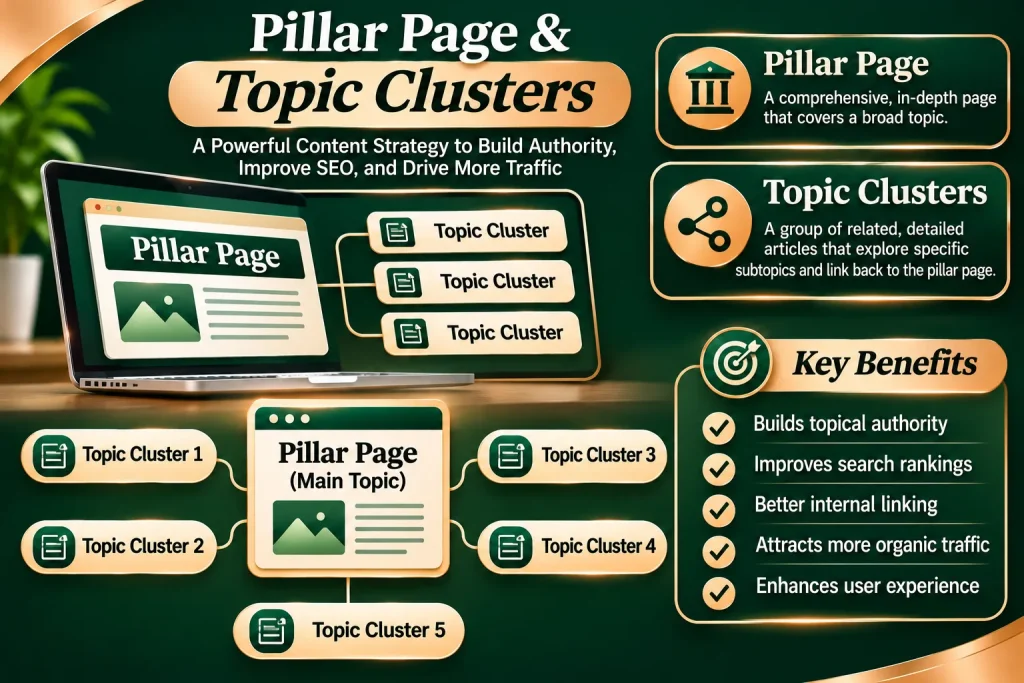
Pillar Page & Topic Clusters Pillar Pages and Topic Clusters: The Ultimate Strategy to Organize Your Content and Dominate GoogleHave you ever wondered how some websites manage to land on the first page of Google for highly competitive keywords, while others struggle to get noticed even for long-tail search terms?The secret isn’t just writing longer articles or building endless backlinks. The real secret lies in how you organize your website architecture.Years ago, you could rank on Google by simply writing a single keyword-stuffed blog post. Today, search engine algorithms are incredibly smart. They no longer look at keywords in isolation. Instead, they look for Topical Authority. Google wants to see that your website is an absolute expert on a specific subject.If your blog looks like a random collection of thoughts thrown together without a clear structure, search engines will struggle to understand your site layout. By restructuring your content around semantic hubs, you make it easy for both search engine bots and human visitors to navigate your site, resulting in higher rankings and explosive organic traffic. What is the Pillar Page and Topic Cluster Models ? If you throw thousands of books onto the floor without any organization, no one will find what they are looking for. However, if you organize books by genre, author, and sub- topic, navigating the library becomes effortless.The pillar-and-cluster strategy operates exactly like an organized library, dividing your content into three interconnected components: The Pillar Page: A comprehensive, high-level guide that covers a broad core topic inside out. It touches upon all aspects of the subject but leaves room for detailed expansion. Topic Clusters (Sub-pages): A collection of hyper-specific, deeply researched blog posts that dive into the individual sub-topics mentioned on your main pillar page.  Internal Hyperlinks: The strategic connective tissue.When you link your articles together using this clean structural hierarchy, you pass algorithmic value (“SEO juice”) across your entire site. If one cluster post starts ranking brilliantly, it pulls the core pillar page and all surrounding sub-pages up with it Why Google Loves Topic Clusters (The Shift to Semantic Search) The way people search the internet has fundamentally evolved. Instead of typing fragmented keywords like “best running shoes comfort,” users now ask natural conversational questions or use voice search assistants, typing queries like, “What are the most comfortable running shoes for flat feet with high arches?”To keep up with this humanized search behavior, Google introduced major algorithmic updates like Hummingbird and BERT, transitioning from simple keyword matching to Semantic Search.Semantic search focuses on user intent and context. Google tries to understand the deeper meaning behind a search query.When you deploy a topic cluster strategy, you signal to Google that your site doesn’t just have one lucky article—it offers a comprehensive ecosystem of answers. This instantly boosts your site’s perceived expertise, authoritativeness, and trustworthiness (E-E-A-T), which are the foundational building blocks of modern SEO. Step-by-Step Guide to Creating a Winning Topic Cluster Strategy Building a topical cluster requires careful planning before you ever type a single sentence. Follow this actionable four-step framework to build your own search engine powerhouse. Step 1: Choose Your Core Topic (The Pillar) Your core topic needs to be broad enough to spawn at least 8 to 20 individual blog posts, but narrow enough that it remains highly relevant to your business goals.• Bad Example: “Digital Marketing” (Too broad; you cannot cover this effectively on one page).• Bad Example: “How to set up a Facebook Ad pixel” (Too narrow; this is a single blog post, not a pillar).• Great Example: “The Ultimate Guide to Social Media Marketing” (Perfect balance; allows you to branch off into specific sub-topics). Step 2: Perform Intent-Driven Keyword Research Once you have your broad pillar topic, you need to uncover the specific questions your target audience is asking. Use keyword research tools like Ahrefs or Semrush to find related long-tail search queries.For our Social Media Marketing pillar example, your cluster keywords might look like this:• Instagram Reels optimization strategies• How to run LinkedIn Lead Gen forms• A beginner’s guide to TikTok analytics• Best times to post on social media channels Step 3: Write and Structure Your Pillar Page Your pillar page needs to be comprehensive, acting as the ultimate 101 guide for the chosen subject.• Break the page down using highly descriptive header tags (H2, H3, and H4).• Provide clear, concise overviews of each sub-topic without giving away all the fine details.• Place an interactive table of contents right at the top of the page so users can quickly skip to the sections they care about most. Step 4: Write the Cluster Posts and Connect the Link Now, write the detailed sub-pages focusing heavily on providing actionable solutions for those specific long-tail keywords.Once written, execute the most important step: The Internal Linking Process. Inside your pillar page, find the brief summary of a sub-topic and insert an anchor link directly to the deep-dive cluster post. Conversely, inside the cluster post, make sure to include a clear link back to the main pillar page within the first few paragraphs. 3 Different Types of Pillar Pages You Can Build Depending on your business model and target audience, you can structure your pillar pages in a few different formats: 1. The Resource Pillar Page This operates as a curated directory of top-tier resources. It features short bookmark style descriptions of a topic alongside high-value outbound and internal links. It is designed to save users hours of search time by aggregating everything they need in one clean hub. 2. The 101 Guide Pillar Page This is the most common format. It takes a complex subject and breaks it down into an easy-to-understand foundational textbook. It explains the What, Why, and How of a topic, serving as the ultimate starting point for beginners entering an industry. 3. The Product or Service Pillar Page Perfect for B2B enterprises and e-commerce brands. This page focuses on a core business offering, mapping out every possible feature, use-case, comparison, and FAQ that a buyer might

Content Marketing

B2B Content Marketing ROI

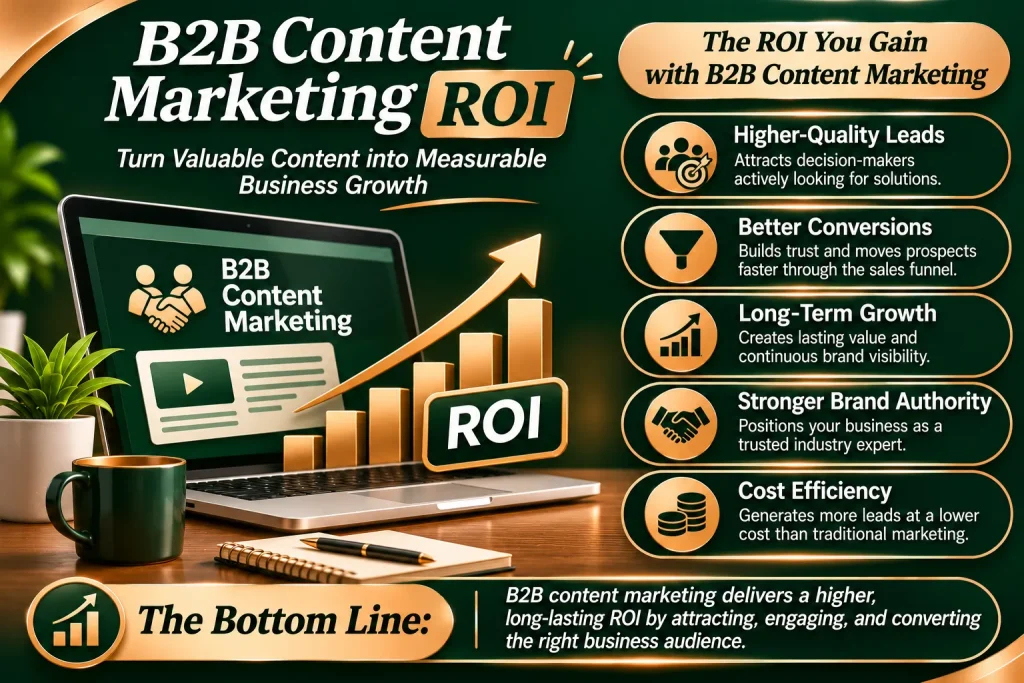
B2B Content Marketing ROI Stop guessing if your content is working. Learn how to accurately measure B2B content marketing ROI, calculate attribution, and track revenue-driving metrics. Let’s address the elephant in the room: measuring the exact return on investment (ROI) of B2B content marketing is incredibly frustrating. If you’ve ever worked in marketing leadership, you know the drill. You’re cornered by a CFO demanding to know exactly how much revenue last month’s blog posts, case studies, or whitepapers brought in. If your answer is a vague list of vanity metrics like page views, social shares, or organic keyword rankings, you can practically watch their eyes glaze over. In the real business world, likes don’t buy budget. Revenue does. The corporate reality is harsh but simple: when budgets get tight, content is usually the first thing on the chopping block if you cannot link creative output directly to the sales pipeline. Yet, content remains the primary engine driving modern buying journeys. Buyers gather information in the shadows, consuming your articles and downloading your guides long before they ever raise their hand to speak to a sales representative. If you cannot track this invisible journey, you are essentially driving your marketing strategy in pitch-black darkness. This practical guide skips the marketing fluff. Instead, we are diving into a finance-approved, common-sense framework to calculate, track, and scale your B2B content marketing ROI. Why Measuring Content ROI is a Unique B2B Challenge Measuring ROI for a simple direct-response ad campaign is easy. A user clicks an ad, lands on a product page, buys a product for ₹5,000, and you instantly know your customer acquisition cost (CAC) and return on ad spend (ROAS). B2B content marketing operates in a completely different universe. The Complex B2B Buying Ecosystem 1. Extended Sales Cycles: A typical enterprise B2B deal takes anywhere from 3 to 9 months to close. A piece of content read in January might not yield a single rupee of revenue until October. 2. The Fragmented Buying Committee: You aren’t marketing to a single impulsive shopper. You are marketing to a committee of 6 to 10 stakeholders—including daily users, IT security leads, finance heads, and VPs. One person might read your technical blog, while another reviews your security whitepaper. 3. The Multi-Touch Journey: A single buyer will likely interact with your brand 15 to 20 times across multiple channels (organic search, LinkedIn, newsletters, webinars) before conversion. Isolating the financial impact of a single blog post is near impossible without the right framework. Because of this complexity, traditional attribution models usually fail. To prove true value, you must stop treating content as a series of isolated articles and start looking at it as an integrated financial funnel. The Core Financial Formula for Content Marketing ROI Before diving into complex tracking setups, you must ground your analysis in basic financial logic. At its absolute foundation, ROI is a calculation of net profit relative to your total investment. The standard mathematical formula for calculating content marketing ROI To apply this formula accurately without getting pushback from finance, you must break down both variables with clinical precision. Variable A: Total Content Investment (The Real Costs) Do not make the rookie mistake of only counting external freelance writing invoices. Your true cost basis must include: Human Resources: Internal employee salaries scaled by the exact percentage of time they spend on content strategy, writing, editing, and distribution. External Production: Direct fees paid to freelance writers, graphic designers, video editors, and agency partners. Variable B: Financial Return from Content (The Revenue) This is where alignment with your sales and finance teams is vital. You must establish clear definitions for: First-Touch Revenue: The total contract value generated from a customer whose very first interaction with your brand was a specific piece of content. Multi-Touch / Influenced Revenue: The total value of deals that engaged with your content assets at any point during their active buying cycle. The Three Phases of Content ROI Maturity You cannot jump from tracking basic website page views straight to advanced, multi-touch algorithmic attribution overnight. Trying to build an enterprise-grade measurement system immediately usually results in data paralysis. Instead, scale your measurement strategy across three distinct phases of operational maturity: Phase 1: Operational Metrics Tracks Traffic, Time on Page, Bounce Rates, and Keyword Rankings using Google Analytics 4 and Google Search Console to validate target audience engagement and content quality. Phase 2: Pipeline Metrics Tracks Form Submissions, Lead Magnet Downloads, MQLs, and SQLs using HubSpot, Marketo, and basic CRM triggers to bridge the gap between reading content and creating pipeline. Phase 3: Revenue Metrics Tracks Customer Acquisition Cost (CAC), Customer Lifetime Value (LTV), and Influenced Pipeline Value using Salesforce and advanced attribution software to map content consumption directly to closed-won deals and revenue. Phase 1: Operational & Engagement Metrics (The Foundation) Operational metrics are leading indicators. While they do not directly prove revenue, they tell you whether your target audience actually cares about what you are publishing. If your time-on-page is under 30 seconds and your bounce rate is over 80%, your content isn’t high enough quality to drive downstream financial conversions. Phase 2: Pipeline Metrics (The Bridge) This phase connects content consumption to active business lead generation. Here, you track Marketing Qualified Leads (MQLs)—users who transition from casual readers into known prospects by exchanging their business email for a high-value content asset like a whitepaper, proprietary data report, or template tool Phase 3: Revenue Metrics (The Goal) This is the ultimate stage of marketing maturity. Here, your content analytics platform is fully integrated with your CRM (like Salesforce). You can see that a specific enterprise account read four blog posts, downloaded a case study, and later closed as a high-value deal. A Simple Step-by-Step Implementation Strategy If you want to transition your marketing department into a data-driven revenue engine, execute this practical implementation plan.• Implement Dynamic UTM Parameter Standards: Never publish or distribute a piece of content without strict UTM tracking parameters attached to its links. Standardise your

Content Marketing

B2B Content Marketing Guide

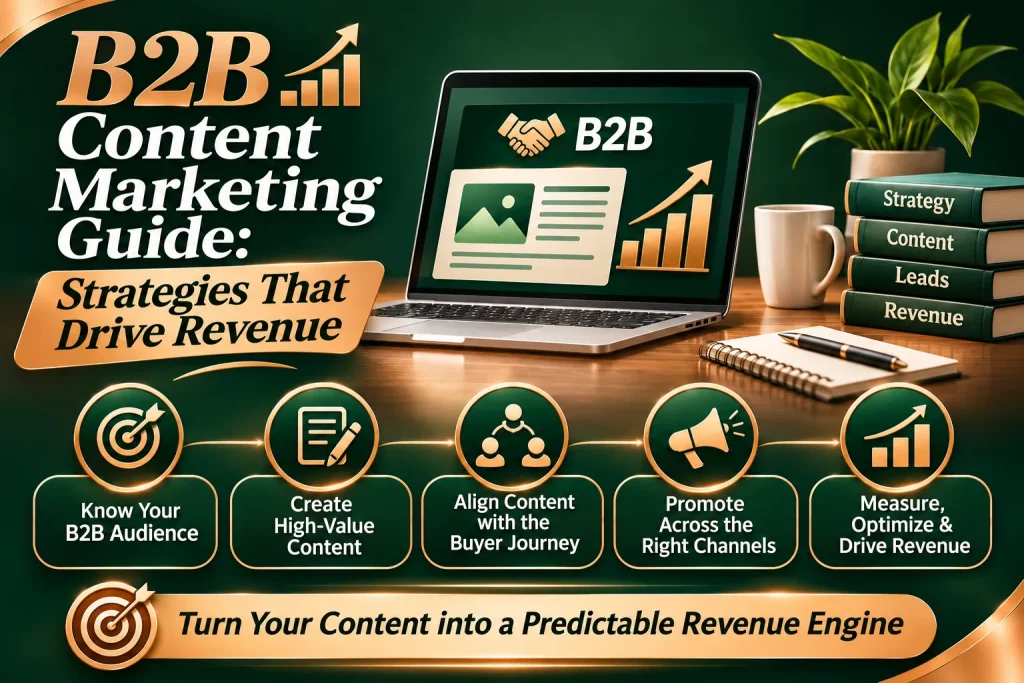
B2B Content Marketing Guide: Strategies That Drive Revenue Stop wasting time on fluff. Master B2B content marketing with this practical guide to building a data-driven strategy that turns readers into buyers.Let’s be honest: the old B2B playbook is completely dead.Think back to how you bought software or hired an agency five years ago. You’d pick up the phone, hop on a demo, and let a sales rep guide you through the features. Today? That sounds exhausting. Modern B2B buyers are hyper-independent. We do our homework in the shadows long before we ever think about clicking that “Book a Demo” button. We read articles, tear apart case studies, scroll through communities, and compare tools completely on our own terms.Here is the cold, hard truth: if your business isn’t showing up with the right answers during that quiet research phase, you simply don’t exist to them.This is exactly why B2B content marketing isn’t just a side project or a nice-to-have line item in your budget—it is the foundation of modern pipeline generation. But let’s clarify one thing: this isn’t about churning out generic 500-word blog posts or clogging up feeds with corporate jargon. It’s about building a high-value ecosystem that grabs the right eyes, builds instant trust, and hooks major accounts.Let’s skip the boring textbook definitions and dive straight into how you can build a content strategy that actually drives revenue. The Reality Check: B2B vs. B2C To win at this game, you need to throw the B2C playbook straight into the bin. B2C marketing wins by triggering fast, emotional impulses—like buying a pair of sneakers at midnight because of a flashy Instagram ad. B2B is a completely different world. It runs entirely on cold logic, operational efficiency, and proving a clear return on investment (ROI).Here is what you are actually dealing with in B2B: The Dreaded Buying Committee: You are almost never selling to just one person. You have to convince the manager who will use the tool daily, the IT lead who worries about security, the CFO who hoards the budget, and the VP who signs the ultimate check. Your content needs to give all of them a reason to say yes. The Long Game: B2B sales cycles don’t happen overnight; they take months. Your content needs to act as a patient guide, quietly nurturing leads and handling their doubts behind the scenes over a long period. Massive Stakes: Because B2B contracts often run into tens or hundreds of thousands of dollars, mistakes can cost people their jobs. Buyers are naturally terrified of making the wrong choice. Your content’s primary job is to make buying from you feel like the safest bet they can make. Setting Up Your Strategy (Without the Fluff) Writing without a strategy is like driving in the dark without headlights—you might move forward, but you are going to crash. Before you open a blank document, you need a blueprint. Step 1: Meet Your Ideal Customer Profile (ICP) If you try to write for everybody, you end up connecting with nobody. Get hyper-specific about your target audience. Don’t just list their job titles; ask yourself the real questions:• What daily bottleneck drives them absolutely crazy?• What specific metrics are they judged on during their annual performance review? Step 2: Mapping the Content Funnel to Real Human Behavior Your content shouldn’t just look pretty; it needs a specific job to do. Break your content down into three clear stages:1. Top of the Funnel (TOFU) – Awareness: This is educational content for people who realize they have a problem but aren’t sure how to fix it yet. Keep it broad and genuinely helpful. (e.g., “Why Your Team’s Supply Chain Expenses Are Skyrocketing This Quarter”)2. Middle of the Funnel (MOFU) – Consideration: Here, the reader knows exactly what their problem is and is actively looking for options. Your job is to guide them toward your category. (e.g., “The Modern Manager’s Guide to Choosing Supply Chain Automation Tools”)3. Bottom of the Funnel (BOFU) – Decision: This is where the gloves come off. The reader is ready to buy and is choosing between you and your top competitor. Use heavy-hitting proof. Execution: Turning Strategy Into Action Too many marketers get trapped chasing massive search volume because it looks great on monthly reports. In B2B, random traffic doesn’t pay the bills—the right traffic does. Focus heavily on intent. A long-tail keyword like “enterprise CRM platform for real estate brokers” might only get 50 searches a month, but the person typing that is practically holding their credit card out. Target those high-intent, problem-solving keywords first. Write Like a Human, Not a Corporate Robot The absolute biggest mistake in B2B writing is hiding behind complex jargon to sound “professional.” It just makes your writing incredibly boring and hard to read. Remember, executives are just regular people who happen to be at work.• Be Actionable: Don’t just explain what a concept is. Tell them exactly how to implement it tomorrow morning.• Bring the Receipts: Back up your claims with real-world data, internal statistics, and reputable industry studies.• Keep it Punchy: Write clear, short sentences. Use conversational language. If you wouldn’t say a phrase out loud to a colleague over coffee, don’t write it in your blog. The Metrics That Actually Matter If you are evaluating your content’s success solely based on page views or social media likes, you are setting yourself up for frustration. Vanity metrics lie. To understand if your content is actually working, you need to track indicators that tie directly to your sales pipeline: • Marketing Qualified Leads (MQLs): How many people loved an article enough to download an in-depth ebook, sign up for your newsletter, or register for a webinar? • Content-Influenced Pipeline: Look at your recently closed deals. Did those buyers read three of your blogs or download a case study before reaching out to sales? • Conversion Rate Optimization (CRO): Are your informational blog posts successfully guiding readers to your product or booking pages? Ready to Scale Your B2B

SEO

What is Programmatic SEO

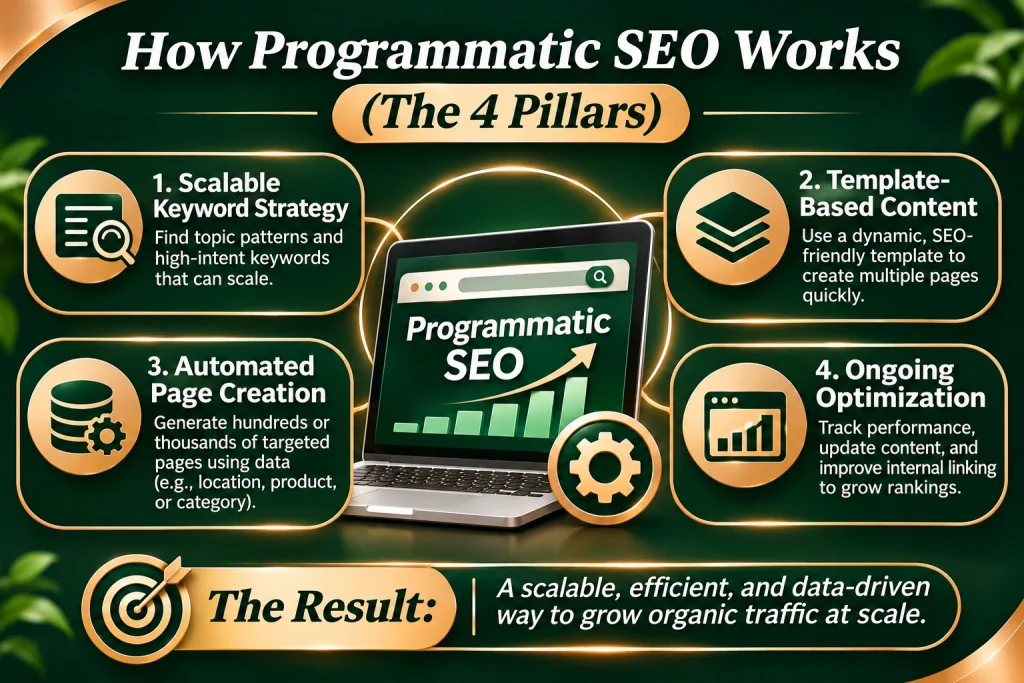
The Ultimate Guide to Programmatic SEO  Imagine creating 1,000 high-quality, targeted landing pages on your website in just a few days. Sounds completely impossible, right? With traditional content creation, it definitely is. But with Programmatic SEO (pSEO), it is not only possible, but it is also one of the most powerful digital marketing strategies used to dominate search engine results pages (SERPs).If you want to scale your organic traffic exponentially without hiring an army of writers or losing your mind over manual content creation, this comprehensive guide is tailored for you Programmatic SEO is the strategic practice of addressing search intent at scale by publishing thousands of landing pages using a database, a dynamic template, and automation.Instead of writing every single article or landing page completely from scratch, you build an automated or semi-automated system. This system injects structured data into highly optimized templates to generate unique pages based on specific user search patterns A Real-World Example Think of global platforms like Tripadvisor or Yelp. Their marketing teams do not manually sit down to write a fresh blog post for “Best Hotels in Paris,” “Best Hotels in New York,” and “Best Hotels in Tokyo.”Instead, they leverage an architectural approach:• A massive central database filled with hotel information, ratings, and city names.• A single, masterfully designed webpage template.• An automated code setup that merges the two, creating millions of search-optimized pages instantly Traditional SEO vs. Programmatic SEO While both approaches have the exact same goal—getting your website to the top of Google—the way you execute them is completely different. Here is how they stack up against each other: Content Creation • Traditional SEO: Manual process where human writers draft every single piece one by one.• Programmatic SEO: Fully automated setup using database rows and smart page templates. Keywords Targeted • Traditional SEO: High-volume, highly competitive short phrases that take months to rank for.• Programmatic SEO: Low-volume, hyper-specific long-tail phrases that bring ready-to-buy visitors. Speed to Scale • Traditional SEO: Slow and linear progress, typically averaging just a few posts every week.• Programmatic SEO: Fast and exponential growth with thousands of helpful pages launched instantly. Core Focus • Traditional SEO: In-depth storytelling, personal opinions, and editorial brand essays.• Programmatic SEO: Data-driven layouts, quick structural answers, and instant user utility. How Programmatic SEO Works (The 4 Pillars) Building a successful pSEO setup isn’t magic; it comes down to getting four simple steps right: 1. Finding Your Keyword Pattern Programmatic SEO relies entirely on keyword modifiers. You are looking for a core head term combined with specific variables that repeat over and over.• Head Term: “Best CRM software for…”• The Result: 3 unique, highly targeted search terms generated from a single core idea. 2 Gathering the Data Once you know your pattern, you need high-quality data to fill those pages. Your database is the heart of your content. You can get this data by:• Using public APIs or trusted government data sources.• Ethically collecting or scraping public web data.• Using your own internal data or user reviews. 3. Designing a Helpful Template Next, you need to build a single webpage template designed to give the searcher exactly what they want. This template uses placeholders where your database information will automatically drop in (like {Software_Name}, {Pricing}, or {Key_Features}). A great template uses comparison tables and simple charts so the visitor can scan the page and get answers instantly. 4. Setting up the Automation Stack Thanks to modern no-code tools, you don’t even need to be a programmer to do this. You can store your data in Airtable, use a syncing tool like Whalesync, and connect it to a website platform like Webflow or WordPress to publish your pages automatically. Real Brands Dominating with SEO You probably interact with programmatic pages every day without realizing it. Here are a few great examples: • Zapier: They mapped out a massive directory connecting thousands of apps. By automating pages for every single combination (like “How to connect Slack with Asana”), they built over 50,000 highly targeted landing pages that bring in millions of visitors a month. • Canva: They created specific landing pages for every type of design template you could think of. When you search for “Free Instagram Story Template for Fitness”, Google sends you straight to a custom Canva page built just for that search. • Nomad List: They gathered public data on safety, cost of living, and internet speeds for cities all over the world. They turned that raw data into thousands of automated city profile pages specifically targeting digital nomads. Conclusion Programmatic SEO changes the game because it shifts your focus from writing articles to building smart data systems. By finding repeatable keyword patterns and pairing them with clean, helpful layouts, you build a traffic machine that works for you 24/7. Find your data angle, design your layout, and start scaling. Frequently Asked Questions 1. Does Google penalize programmatic SEO pages? No. Google doesn’t care whether your page was generated by a script or written line-by-line by a human. Google only cares if the page is helpful. If your pages provide great data, a solid layout, and truly answer the searcher’s question, they will rank well. 2. Do I need to know how to code? Not anymore. With the rise of no-code tools, you can easily link an Airtable database straight to a WordPress or Webflow site using basic plugins. You can launch a massive pSEO project without writing a single line of code. 3. How many pages should I publish first? Always start small. Launch a test batch of 50 to 200 pages. Give Google a few weeks to crawl and index them. Once you see that they are indexing properly and look great to real users, go ahead and publish the rest of your database. 4. What is the difference between a head term and a modifier? The head term is the core topic you are targeting (e.g., “Developer jobs”). The modifier is the variable that changes to create long-tail variations

SEO

Multi-Model SEO

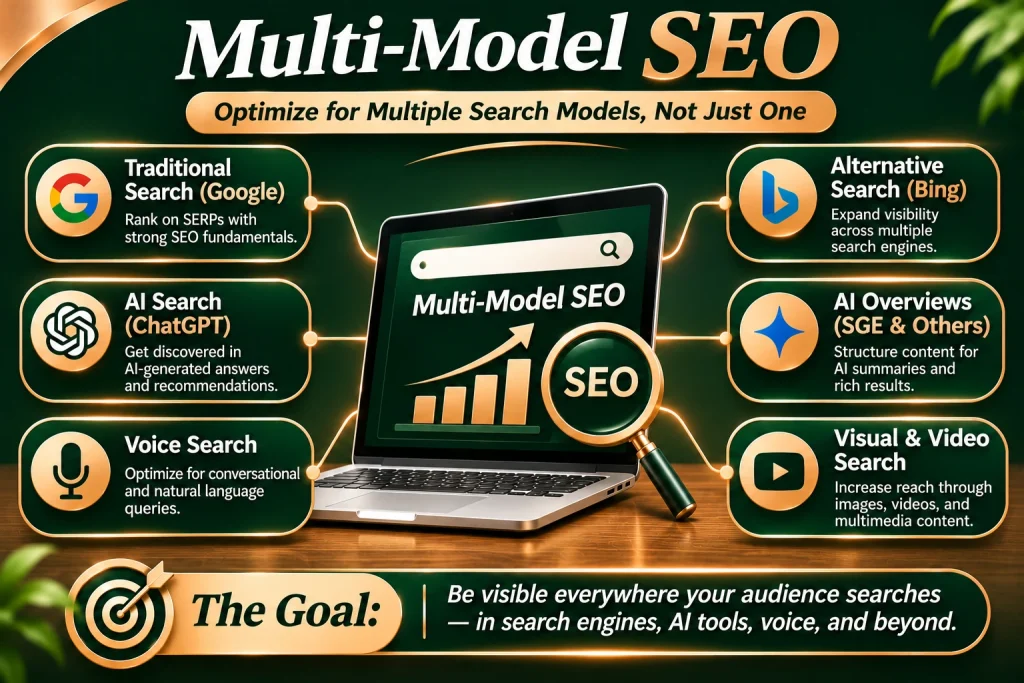
Multi-Model SEO The landscape of search engine optimization is undergoing its most radical transformation since the inception of the internet. For over two decades, the formula for online visibility was straightforward: write content, insert keywords, build backlinks, and please the Google algorithm. If you did this right, you landed on the coveted first page of Google’s blue links.Today, that playbook is no longer enough.We have entered the era of the Generative AI Search. Millions of internet users are bypassing traditional search bars entirely. Instead, they are turning to conversational AI platforms like ChatGPT, Google Gemini, Microsoft Copilot, Apple Intelligence, and Perplexity AI to find information, compare products, and solve problems.To survive and thrive in this new digital ecosystem, you need to transition from traditional SEO to Multi-Model SEO (also known as LLMO or Large Language Model Optimization). This ultimate guide will break down exactly what Multi-Model SEO is, why it matters, and how you can optimize your website to rank across every major AI engine and traditional search platform. What is Multi-Model SEO? Multi-Model SEO is the practice of optimizing your digital content so that it can be easily crawled, understood, synthesized, and cited by multiple types of search engines—specifically traditional algorithmic search engines (like Google and Bing) and Generative AI Large Language Models (like OpenAI’s GPT-4, Anthropic’s Claude, and Google’s Gemini).The term “Multi-Model” refers to the diverse ecosystem of AI models that power modern search. Instead of optimizing for just one master algorithm (Google’s PageRank variants), you are now optimizing for systems that process natural language, images, voice commands, and complex reasoning patterns simultaneously.The Shift from Keywords to Vector EmbeddingsTraditional search relies heavily on keyword matching. If someone typed “best running shoes,” Google looked for pages containing that exact phrase or close variations.AI models operate on Vector Search and Semantic Understandings. They convert your content into mathematical vectors to grasp the deeper context, intent, and relationships between concepts. Therefore, Multi-Model SEO focuses less on how many times you repeat a keyword and more on the depth, accuracy, and structure of your information. Why You Must Adapt to Multi-Model SEO Today If your traffic relies entirely on traditional search clicks, your business is at risk. Here is why adopting a multi-model approach is urgent: • The Rise of Zero-Click Searches: AI engines generate direct answers right on the search results page (like Google’s AI Overviews). Users get the answer they need without ever clicking through to a website.• AI Search as the New Gatekeeper: Tools like Perplexity and ChatGPT act as personalized research assistants. If your website isn’t cited in their responses, you lose out on a massive, highly qualified audience.• Voice and Visual Search Expansion: Multi-model AI systems seamlessly integrate voice inputs and image uploads. Your text content must be optimized to align with how people talk and what they see, not just what they type. The Core Framework of Multi-Model SEO To build an effective Multi-Model SEO strategy, you must understand the four pillars of how modern AI models evaluate and recommend content. 1. Data Infrastructure & Machine Readability Before an AI model can recommend your content, its underlying web scraper (like GPTBot or Google-Extended) must be able to parse your site cleanly. Clean code, fast loading speeds, and robust schema data act as the foundation. 2. Semantic Authority AI models prioritize deep data over superficial summaries. You must cover topics exhaustively, answering primary, secondary, and tertiary user queries within a single cohesive content hub. 3. Reputation and Brand Footprint LLMs are trained on massive datasets containing books, news articles, forums, and academic papers. If your brand or authors are mentioned positively across multiple third-party platforms, AI engines treat your site as an authoritative source. 4. User Experience & Learning to Rank (LTR) Both AI engines and traditional algorithms look at user signals. If a user follows a link from ChatGPT to your site and immediately leaves because the page is cluttered or hard to read, the AI learns that your site is a poor recommendation. Traditional SEO vs. Multi-Model SEO: A Direct Comparison To succeed in this hybrid landscape, you need to understand how traditional search optimization differs from modern AI optimization. Both are important, but they require different focuses: • Primary Target: Traditional SEO targets Google and Bing algorithmic crawlers, while Multi-Model SEO focuses on LLMs, Vector Databases, and Chat Interfaces.• Keyword Strategy: Traditional SEO relies on strict keyword density and search volume focus, whereas Multi-Model SEO uses semantic clusters, entities, and conversational intent.• Content Goal: Traditional SEO aims for a high click-through rate (CTR) from SERPs, while Multi-Model SEO strives for inclusion in AI summaries and direct citations.• Formatting: Traditional SEO uses standard H1, H2, H3 tags with long-form text, whereas Multi-Model SEO utilizes bulleted data fragments, definition lists, and structured tables.• Success Metric: Traditional SEO measures organic keyword rankings and organic traffic, while Multi-Model SEO tracks Share of Model Voice (SoMV) and citation traffic Frequently Asked Questions Q1 What is the difference between Google SEO and ChatGPT Optimization? Google SEO focuses on optimizing for traditional ranking factors like backlinks, core web vitals, and algorithmic keyword matching to earn clicks on a web page. ChatGPT Optimization (LLMO) focuses on semantic clarity, conversational context, structured data, and building a broad digital brand footprint so that the AI model references and cites your brand within its conversational responses. Q2 Will Multi-Model SEO replace traditional SEO entirely? No, Multi-Model SEO expands upon traditional SEO. Traditional search engines like Google still drive massive amounts of traffic, but they are integrating AI features into their core interfaces. Doing Multi-Model SEO ensures your site ranks well in traditional search results while simultaneously qualifying you for selection in AI-generated answers and voice searches. Q3 How do I know if my website is ranking or cited in AI search engines? A you can track your AI visibility by manually testing high-intent conversational queries related to your niche inside ChatGPT Search, Gemini, and Perplexity to see if your site is cited. Additionally, modern

SEO

Local SEO for Small Businesses

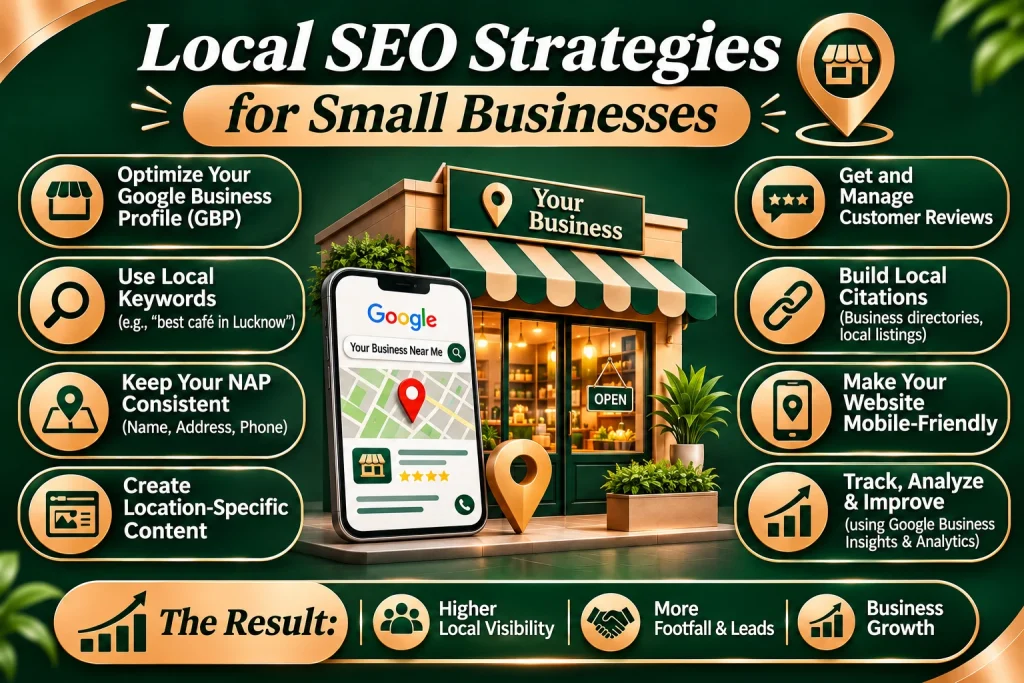
Local SEO Strategies for Small Businesses If you run a small business, you already know that your local community is the backbone of your success. Whether you are running a cozy neighborhood coffee shop, managing a fast-moving roofing crew, or styling customers at a local boutique, you need a reliable way to get noticed. You need to be the business that pops up when someone nearby is looking for exactly what you offer.That is where Local Search Engine Optimization (Local SEO) comes into play.Think about it: when people want to find a service, buy a product, or grab a bite, they pull out their phones and search. Nearly half of all Google searches have “local intent.” Even better, the vast majority of people who do a local search end up walking through a physical storefront within 24 hours. If your business isn’t showing up in those moments, you are essentially handing your hard-earned customers over to your competitors.Let’s break down exactly how you can fix that. This guide will walk you through easy, realistic local SEO strategies that will rank your business higher, win more clicks, and turn online searches into real-world handshakes. What on Earth is Local SEO anyway? At its core, local SEO is just the process of making your business visible to people searching in your immediate geographic area. It is why a search for “best tacos” yields results down the street from where you are sitting, rather than a top-tier restaurant three states away.While these searches happen on Google all day long, they also happen on map apps like Google Maps and Apple Maps.Why You Want to Win the “Map Pack”When you type something like “plumber near me” into Google, you’ll notice a distinct box at the top of the page. It features a map and showcases three local business profiles. In the SEO world, we call this the Google Local Map Pack.Getting into this top three spot is your ultimate goal. Why? Because it captures nearly half of all the clicks on the page. It completely bypasses the regular website listings below it. If you can get your business featured here, your phone will start ringing. Claim and Polish Your Google Business Profile If you only have time to do one thing from this list, make it this one. Your Google Business Profile (GBP)—which you might remember as Google My Business—is your absolute most important asset. It is essentially your digital storefront across Google Search and Maps, and it won’t cost you a single cent. How to set it up for success: • Claim and Verify It: Head over to the Google Business Profile site, claim your company, and complete the verification steps. Usually, Google will send you a text, give you a quick call, or ask for a brief video verification of your workspace. • Keep Your Details Identical: Your business Name, Address, and Phone number (NAP) need to be perfectly consistent everywhere. If your website says “Main Street,” don’t type “Main St.” on your Google profile. Keep it matching perfectly so search engines don’t get confused. • Pick the Right Categories: Be specific. If you run an Italian restaurant, don’t just pick “Restaurant.” Choose “Italian Restaurant” as your primary category, and add secondary categories to cover the rest of your menu. • Write a Real Description: You have 750 characters to introduce yourself. Tell a brief story about who you are, what makes you different, and naturally mention the city or town you serve. Don’t just stuff keywords here; write it for a human. • Post Updates Regularly: Treat your profile a bit like a social media page. Drop a post when you have a weekend sale, a new menu item, or an upcoming event. Active profiles tell Google that your business is alive and well. • Show Off with Photos: Upload clear, bright photos of your team, the inside of your store, your products, or your workspace. Businesses with great photos get significantly more requests for driving directions than those without. Find Keywords That Actually Mean Business Keyword research for local businesses isn’t about chasing millions of views. It is about finding the exact phrases your actual customers type in when they are ready to pull out their wallets. Keep it simple with these tactics: • The Service + Location Formula: Start with the basics. Think phrases like “HVAC repair Austin” or “dental clinic downtown Miami”.• Think Like a Customer: People rarely search for corporate industry jargon. • Snoop on Your Competitors: Go look at the businesses currently winning the Map Pack in your area. Look at their websites and profiles. What phrases are they using in their main titles? Don’t copy them blindly, but use their success as a blueprinth Make Your Website Speak “Local” Once you know your local keywords, you need to place them naturally across your website. If your business serves multiple distinct cities or neighborhoods, don’t try to cram them all onto your homepage. Instead, build a clean, dedicated landing page for each specific location. Your Quick On-Page Checklist  • Title Tags: This is the clickable headline that appears in search results. Put your main local keyword right at the beginning. Keep it under 60 characters so it doesn’t get cut        off.• Good Example: Affordable Web Design Chicago  • Meta Descriptions: This is the short summary paragraph below your title. Make it inviting and clear. Tell the reader exactly what to do next.• Good Example: Need reliable web design in Chicago? We build fast, mobile-friendly sites that bring in real customers. Get your free custom quote today! • Headings (H1, H2): Your main page title (the H1) should include your city name. Use your subheadings (H2s) to break down specific services or neighborhoods you cover.  • Drop a Map in the Footer: Go to Google Maps, copy your official listing’s embed code, and paste it directly into your website’s footer or contact page. It is a massive, clear         signal to Google confirming your physical

SEO

GEO vs Traditional SEO

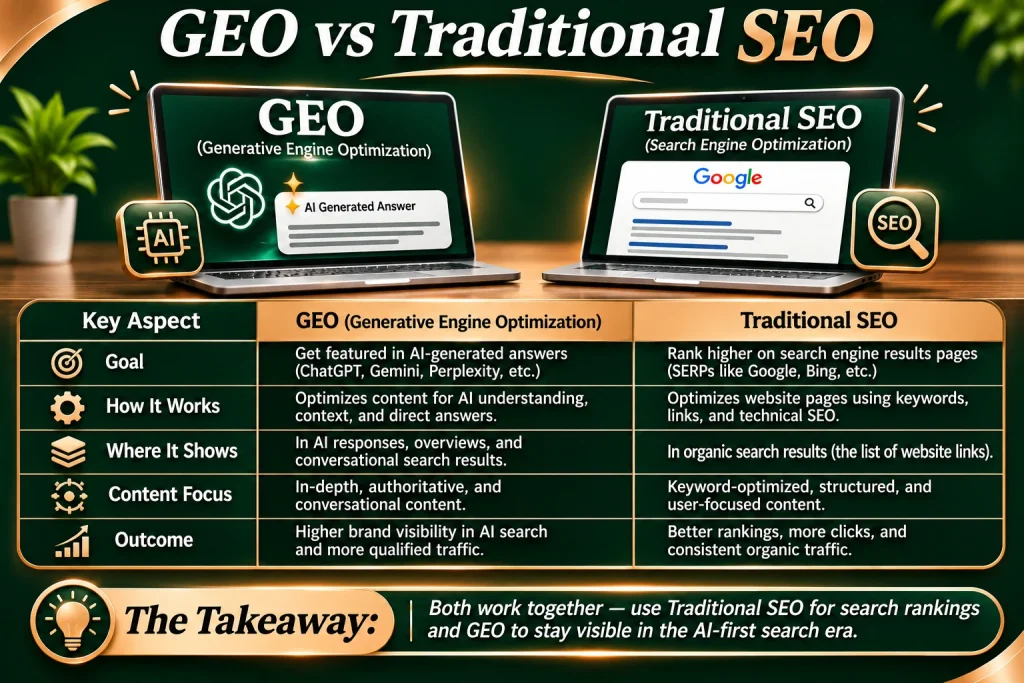
GEO vs Traditional SEO The side people find information online is changing faster than ever. For over twenty years, the playbook for digital marketing was straightforward: you optimized your website for Traditional Search Engine Optimization (SEO), climbed to the top of Google, and watched the traffic roll in.But things look very different now. With the explosion of AI platforms like ChatGPT, Perplexity, Claude, and Google’s AI Overviews, a brand-new playbook has emerged: Generative Engine Optimization (GEO).For marketers and business owners, the challenge is no longer just about beating a competitor for the number one spot on a list of links. The new challenge is making sure that when a user asks an AI engine a question, the AI trusts, selects, and recommends your brand in its answer.In this guide, we will break down the real differences between GEO and traditional SEO in plain English. You will learn how these two worlds fit together and how to adapt your content strategy so your business stays visible, no matter how people choose to search What are we actually talking about? Before we look at how to optimize for these changes, let’s define exactly what these two approaches mean for your business. What is Traditional SEO? Traditional SEO is all about optimizing your website’s code, structure, and content so search engines like Google Search and Microsoft Bing can easily find and rank your pages.The main goal here is to rank your specific URLs as high as possible on the search results page. You want users to see your link, click it, and land directly on your website. What is Generative Engine Optimization (GEO)? GEO is a newer strategy. It focuses on organizing and formatting the information on your website so that Large Language Models (LLMs) can easily read, understand, and use it inside their AI-generated answers.With GEO, you aren’t chasing a traditional ranking position. Instead, you are aiming to be the trusted source that the AI cites and links to when answering a user’s conversational prompt. Key Differences at a Glance • The Core Systems: Traditional SEO targets search engines that sort links, while GEO targets AI systems that synthesize multiple websites into a single answer.• Target Platforms: Traditional SEO runs on Google Search and Microsoft Bing, whereas GEO focuses on ChatGPT, Perplexity, and Google AI Overviews.• The Main Goal: Traditional SEO aims for high rank positions to drive direct website traffic, while GEO works to secure brand mentions and citation links inside AI summaries.• Content Styling: Traditional SEO uses keyword-optimized long-form articles, while GEO relies on direct, fact-heavy answers and highly structured data modules.• Authority Signals: Traditional SEO builds authority via external backlinks, while GEO demands cross-platform brand consistency and verified expert quotes.• Success Metrics: Traditional SEO tracks organic clicks and impressions using tools like Semrush or Ahrefs, while GEO evaluates your Share of Voice inside AI answer interfaces.• User Interaction: Traditional SEO forces users to scroll and click through blue links, while GEO serves the user a single conversational response instantly. How AI Search Works Behind the Scenes To understand GEO, you need to understand a concept called Retrieval-Augmented Generation (RAG). Don’t let the technical name scare you—the process is actually quite simple. When a user types a detailed question into an AI search engine, the system follows three basic steps:1. The Search (Retrieval): The AI instantly scans the web to pull a handful of the best articles and pages related to the question.2. The Filter (Evaluation): The AI reads these pages, filtering out fluff and looking for hard facts, clear structure, and trusted sources.3. The Answer (Synthesis): The AI blends the information from those different websites into one smooth response, adding little clickable citations that link back to the sources it used.If your content is full of fluff and lacks clear facts, the AI will simply skip your page and pull data from a competitor who got straight to the point. How to Keep Winning at Traditional SEO Traditional SEO is definitely not dead. In fact, AI engines usually pull their sources from websites that already rank well in traditional search. To keep your foundational SEO strong, focus on these core areas: • Understand User Intent: Don’t just target keywords because they have high search volume. Write content that directly answers what the user is looking for, whether they want to buy something or just learn how it works. Tools like Semrush and Ahrefs are great for finding these opportunities.• Smart On-Page Setup: Keep using your main keywords naturally in your titles, headings, and body copy. Write helpful alt text for your images and clean up duplicate content.• Fix Technical Issues: Make sure your website loads quickly on mobile phones, uses secure HTTPS, and has a clean sitemap submitted via Google Search Console.• Build Real Authority: Focus on earning high-quality backlinks from respected, relevant websites in your industry. How to Optimize Your Content for GEO Optimizing for AI engines means making your content incredibly easy for a machine to read, verify, and quote. Recent industry studies show that making a few strategic tweaks to your writing can massively increase the chances of an AI quoting your website: Give Direct, Fact-Dense Answers AI models love text that gets straight to the point. Avoid corporate jargon or beating around the bush. Include Clear Data and Statistics Data adds instant credibility. Studies show that including exact percentages, numbers, and verified data points can boost your visibility in AI search by up to 30%.“According to our 2026 internal benchmarking report, our platform reduces project turnaround times by exactly 38% within the first month.” Feature Real Expert Insights AI engines place a high value on true expertise. Adding direct, meaningful quotes from named specialists in your company can increase your AI citation rates by up to 41%. Make sure to include the expert’s full name and job title so the AI can verify who they are. Use Advanced Schema Markup Schema markup is behind-the-scenes code that tells search engines exactly what your content means.

Scroll to Top