
Multi-Model SEO
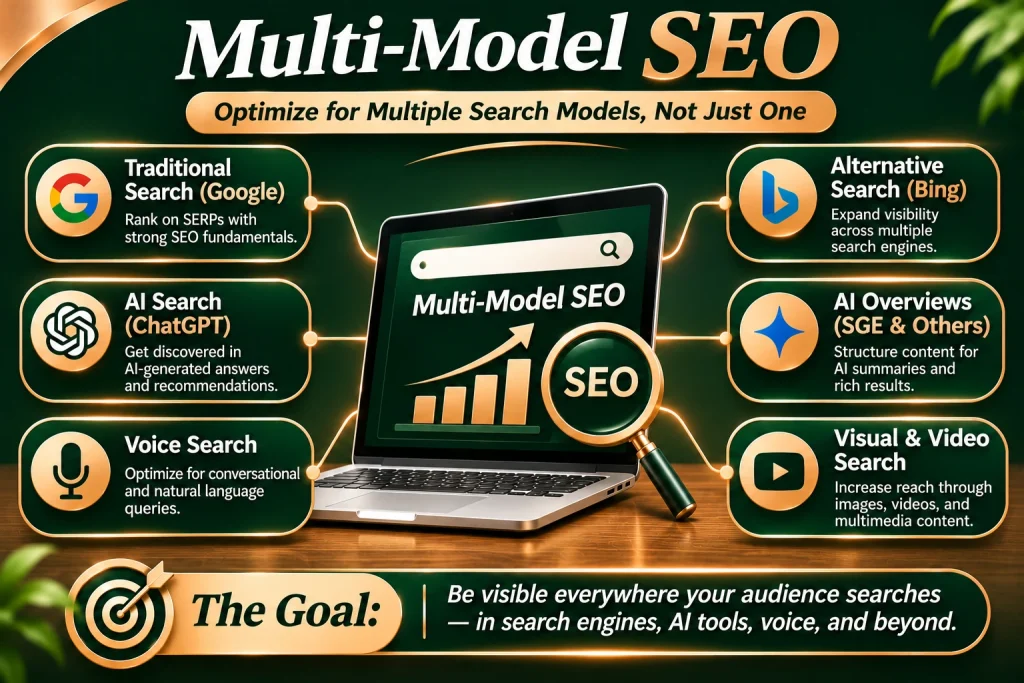
The landscape of search engine optimization is undergoing its most radical transformation since the inception of the internet. For over two decades, the formula for online visibility was straightforward: write content, insert keywords, build backlinks, and please the Google algorithm. If you did this right, you landed on the coveted first page of Google’s blue links.
Today, that playbook is no longer enough.
We have entered the era of the Generative AI Search. Millions of internet users are bypassing traditional search bars entirely. Instead, they are turning to conversational AI platforms like ChatGPT, Google Gemini, Microsoft Copilot, Apple Intelligence, and Perplexity AI to find information, compare products, and solve problems.
To survive and thrive in this new digital ecosystem, you need to transition from traditional SEO to Multi-Model SEO (also known as LLMO or Large Language Model Optimization). This ultimate guide will break down exactly what Multi-Model SEO is, why it matters, and how you can optimize your website to rank across every major AI engine and traditional search platform.
What is Multi-Model SEO?
Multi-Model SEO is the practice of optimizing your digital content so that it can be easily crawled, understood, synthesized, and cited by multiple types of search engines—specifically traditional algorithmic search engines (like Google and Bing) and Generative AI Large Language Models (like OpenAI’s GPT-4, Anthropic’s Claude, and Google’s Gemini).
The term “Multi-Model” refers to the diverse ecosystem of AI models that power modern search. Instead of optimizing for just one master algorithm (Google’s PageRank variants), you are now optimizing for systems that process natural language, images, voice commands, and complex reasoning patterns simultaneously.
The Shift from Keywords to Vector Embeddings
Traditional search relies heavily on keyword matching. If someone typed “best running shoes,” Google looked for pages containing that exact phrase or close variations.
AI models operate on Vector Search and Semantic Understandings. They convert your content into mathematical vectors to grasp the deeper context, intent, and relationships between concepts. Therefore, Multi-Model SEO focuses less on how many times you repeat a keyword and more on the depth, accuracy, and structure of your information.
Why You Must Adapt to Multi-Model SEO Today
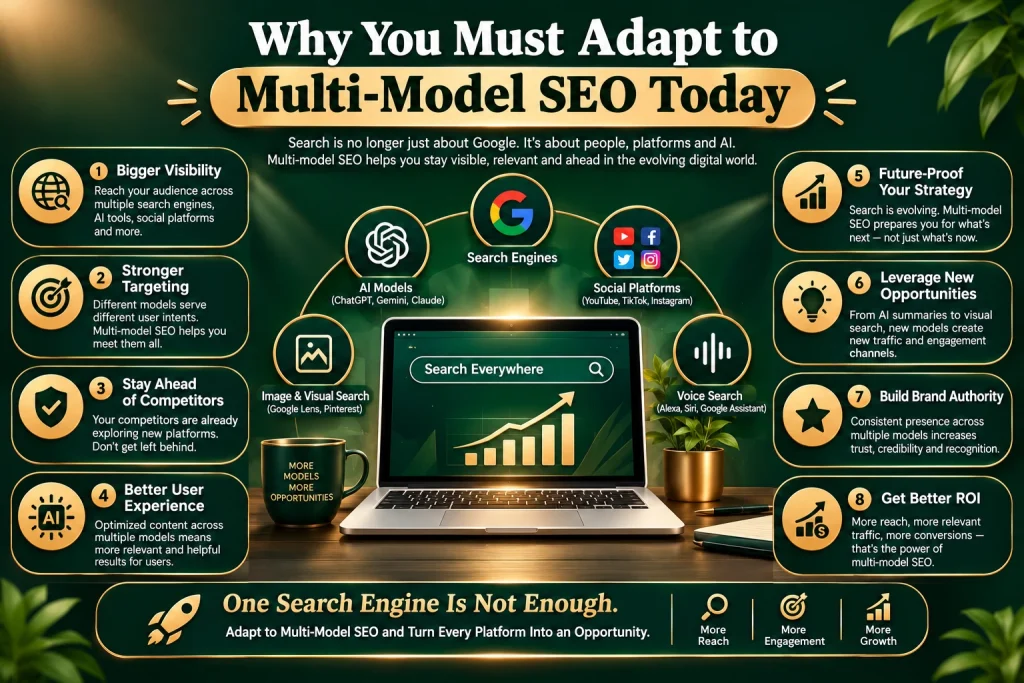
If your traffic relies entirely on traditional search clicks, your business is at risk. Here is why adopting a multi-model approach is urgent:
• The Rise of Zero-Click Searches: AI engines generate direct answers right on the search results page (like Google’s AI Overviews). Users get the answer they need without ever clicking through to a website.
• AI Search as the New Gatekeeper: Tools like Perplexity and ChatGPT act as personalized research assistants. If your website isn’t cited in their responses, you lose out on a massive, highly qualified audience.
• Voice and Visual Search Expansion: Multi-model AI systems seamlessly integrate voice inputs and image uploads. Your text content must be optimized to align with how people talk and what they see, not just what they type.
The Core Framework of Multi-Model SEO
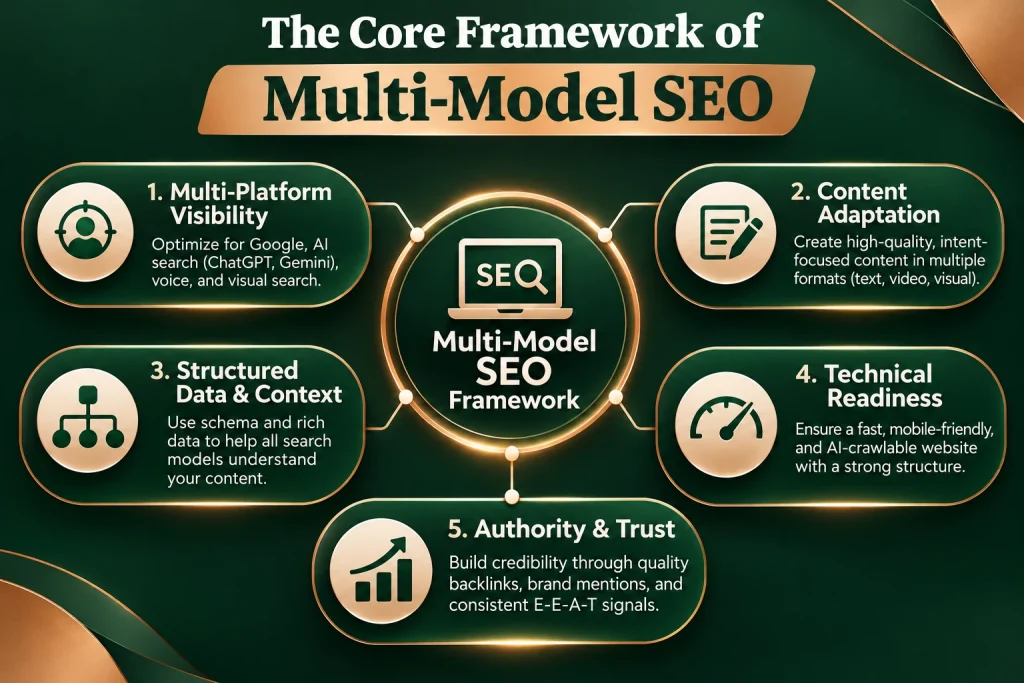
To build an effective Multi-Model SEO strategy, you must understand the four pillars of how modern AI models evaluate and recommend content.
Before an AI model can recommend your content, its underlying web scraper (like GPTBot or Google-Extended) must be able to parse your site cleanly. Clean code, fast loading speeds, and robust schema data act as the foundation.
AI models prioritize deep data over superficial summaries. You must cover topics exhaustively, answering primary, secondary, and tertiary user queries within a single cohesive content hub.
LLMs are trained on massive datasets containing books, news articles, forums, and academic papers. If your brand or authors are mentioned positively across multiple third-party platforms, AI engines treat your site as an authoritative source.
Both AI engines and traditional algorithms look at user signals. If a user follows a link from ChatGPT to your site and immediately leaves because the page is cluttered or hard to read, the AI learns that your site is a poor recommendation.
Traditional SEO vs. Multi-Model SEO: A Direct Comparison
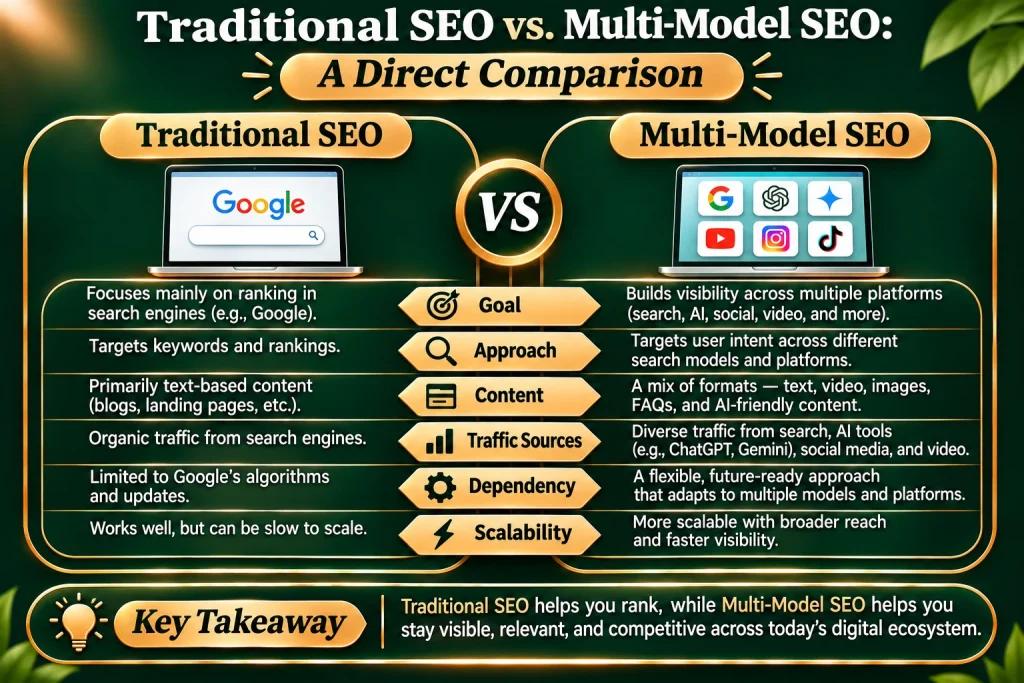
To succeed in this hybrid landscape, you need to understand how traditional search optimization differs from modern AI optimization. Both are important, but they require different focuses:
• Primary Target: Traditional SEO targets Google and Bing algorithmic crawlers, while Multi-Model SEO focuses on LLMs, Vector Databases, and Chat Interfaces.
• Keyword Strategy: Traditional SEO relies on strict keyword density and search volume focus, whereas Multi-Model SEO uses semantic clusters, entities, and conversational intent.
• Content Goal: Traditional SEO aims for a high click-through rate (CTR) from SERPs, while Multi-Model SEO strives for inclusion in AI summaries and direct citations.
• Formatting: Traditional SEO uses standard H1, H2, H3 tags with long-form text, whereas Multi-Model SEO utilizes bulleted data fragments, definition lists, and structured tables.
• Success Metric: Traditional SEO measures organic keyword rankings and organic traffic, while Multi-Model SEO tracks Share of Model Voice (SoMV) and citation traffic
Frequently Asked Questions

Google SEO focuses on optimizing for traditional ranking factors like backlinks, core web vitals, and algorithmic keyword matching to earn clicks on a web page. ChatGPT Optimization (LLMO) focuses on semantic clarity, conversational context, structured data, and building a broad digital brand footprint so that the AI model references and cites your brand within its conversational responses.
No, Multi-Model SEO expands upon traditional SEO. Traditional search engines like Google still drive massive amounts of traffic, but they are integrating AI features into their core interfaces. Doing Multi-Model SEO ensures your site ranks well in traditional search results while simultaneously qualifying you for selection in AI-generated answers and voice searches.
A you can track your AI visibility by manually testing high-intent conversational queries related to your niche inside ChatGPT Search, Gemini, and Perplexity to see if your site is cited. Additionally, modern SEO tools are rolling out “Share of Model Voice” (SoMV) metrics to track how often your brand appears in generative AI answers.
You should only block AI bots if your website contains proprietary data, paywalled content, or private intellectual property that you do not want used for model training. For public blogs, e-commerce stores, and informational websites, allowing AI bots to crawl your site is essential if you want to be cited as a source in conversational search results.