
Storytelling in Marketing: Connect, Engage, and Convert Your Audience
Storytelling in Marketing
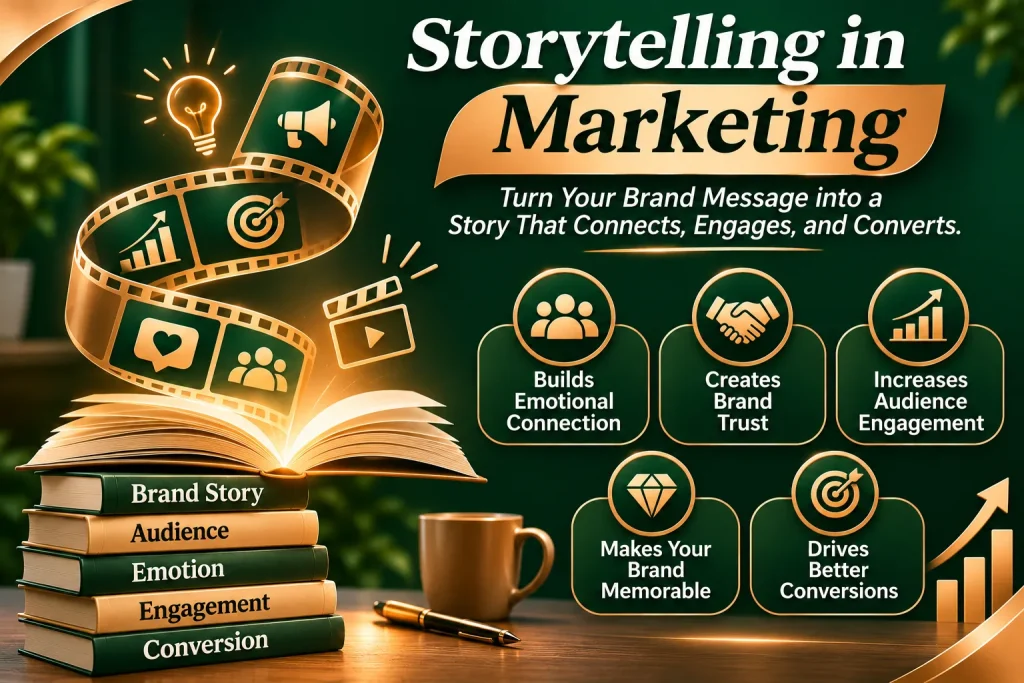
In today’s digital landscape, consumers are bombarded with thousands of advertisements every single day. From social media sponsored posts to billboard ads, the noise is louder than ever. Yet, most businesses fail to capture the one thing they desperately need: attention.
Why do most traditional ads fail? Because people do not buy products; they buy the stories those products represent.
Think about your favorite brands. Why do people queue outside stores for hours for the latest Apple iPhone when cheaper alternatives exist? Why is Nike more than just a shoe company? The answer lies in storytelling.
When you master the art of storytelling in marketing, you stop chasing customers. Instead, you attract a community of loyal advocates. In this ultimate guide, we will break down why storytelling works, the psychological triggers behind it, and a step-by-step framework to implement it into your business strategy.
The Science Behind Story : Why Our Brains Crave Stories
Human beings have been telling stories for thousands of years, from ancient cave paintings to modern cinema. Our brains are hardwired to process information through narrative structures.
When a brand presents dry statistics or features, only the language processing parts of the brain (Broca’s and Wernicke’s areas) are activated. The reader simply decodes the words.
However, when you tell a story, you trigger a phenomenon called neural coupling. The listener’s brain activates the exact same regions as the storyteller’s brain. If your story describes a sensory experience—like the smell of freshly brewed coffee or the stress of losing a business deal—the sensory and motor cortexes light up.
• Cortisol: Focuses our attention by introducing tension or a challenge.
• Oxytocin: Fosters empathy, making the audience trust the storyteller or brand.
• Dopamine: Rewards us when the story reaches a satisfying conclusion, making it memorable.
The Core Framework of an Effective Brand Story
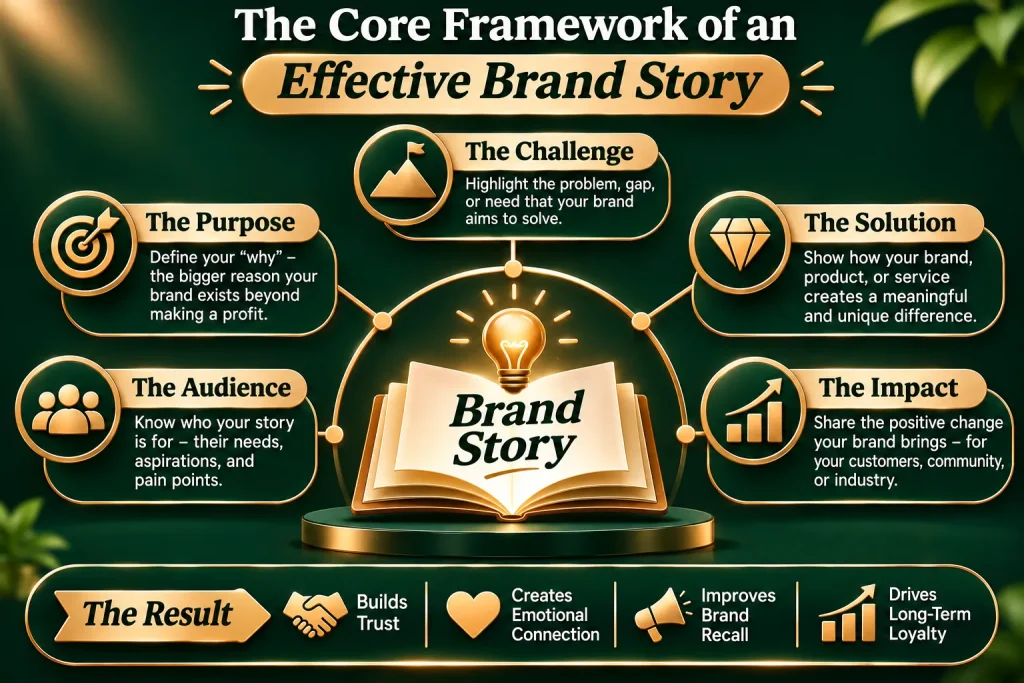
Every great story, from Star Wars to an award-winning Super Bowl commercial, follows a fundamental structure. In marketing, this structure is adapted to position your customer as the true hero.
The biggest mistake companies make is positioning their own brand as the hero. Your brand is not Luke Skywalker; your customer is. Your story must start by introducing your ideal customer, their lifestyle, and their aspirations.
Every hero needs a villain. In marketing, the villain is the specific pain point your customer faces. This can be internal (feeling frustrated or overwhelmed) or external (lacking the right software to automate tasks). Clearly defining the problem builds immediate empathy.
When the hero is stuck, the guide arrives. This is where your brand enters the picture. The guide provides wisdom, tools, and a clear pathway to success. You must demonstrate empathy (understanding their pain) and authority (proving your competence through case studies, testimonials, or data).
Heroes don’t like confusion. You must give them a simple, step-by-step plan that removes the risk of doing business with you. For example:
1. Sign up for a free consultation.
2. Customize your strategic plan.
3. Watch your business scale.
A story without stakes is boring. You must clearly illustrate what the hero’s life will look like if they use your solution (Success) versus what it will look like if they change nothing (Failure).
3 Real-World Examples of Brilliant Marketing Storytelling
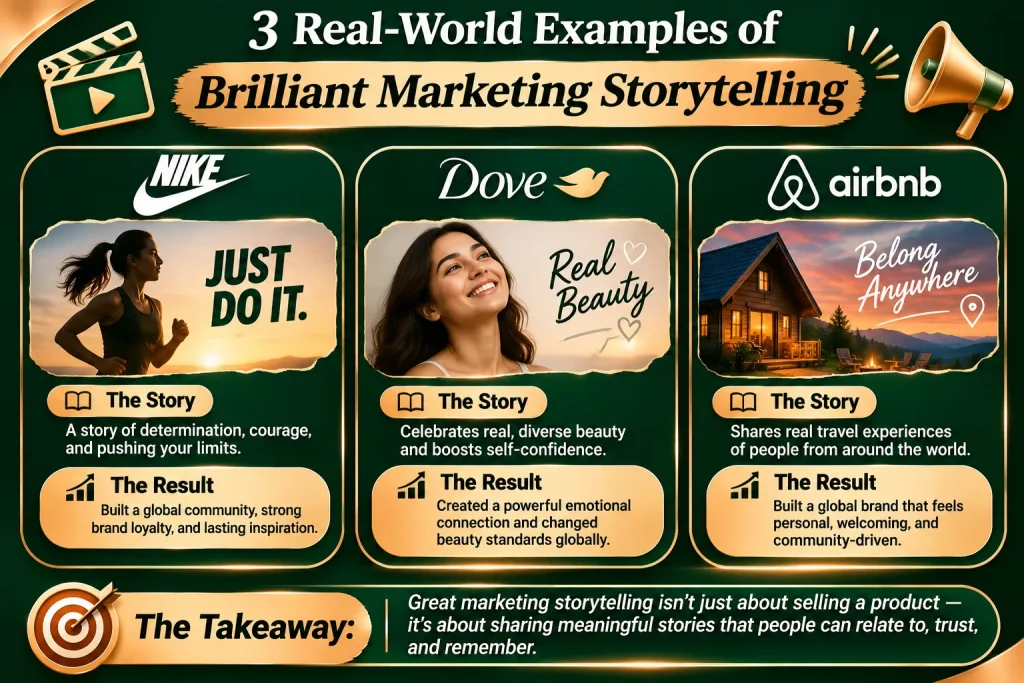
Nike rarely talks about the rubber soles, stitching, or fabric of their shoes. Instead, they tell stories of determination, grit, and overcoming personal boundaries. Their story tells you that anyone can be an athlete, and by wearing Nike, you join that legacy of greatness.
Airbnb shifted its marketing from just renting out spare rooms to creating a sense of global belonging. Their campaigns focus entirely on the hosts and travelers, highlighting human connections across diverse cultures. The product is accommodation; the story is human connection.
Apple’s legendary 1997 campaign did not feature computers. Instead, it celebrated innovators, rebels, and misfits like Albert Einstein and Mahatma Gandhi. The narrative was clear: if you buy an Apple product, you are also someone who thinks differently and wants to change the world.
How to Implement Storytelling Across Your Marketing Channels
Now that you understand the theory, here is how you can apply storytelling practically across your digital channels:
1. Your Website’s “About Us” Page
Stop writing boring corporate histories filled with industry jargon. What frustration led you to start this business? What vision drives your team every morning?
2. Social Media Marketing
Platforms like Instagram, LinkedIn, and TikTok thrive on micro-storytelling. After” stories of your clients. Share behind-the-scenes struggles and triumphs of running your business to humanize your brand.
3. Email Newsletters
Instead of blasting your email list with constant discounts, start your emails with a personal anecdote or a customer success story.
4. Case Studies and Testimonials
Transform dry data into an emotional journey. Instead of stating, “We increased Client X’s traffic by 40%,” structure it as a narrative: “How Client X overcame a devastating drop in sales and bounced back to achieve a record-breaking month.”
Conclusion: Stop Selling, Start Connecting
Features tell, but stories sell. If you want your marketing campaigns to break through the noise, you must appeal to human emotions. By positioning your customer as the hero, addressing their deepest struggles, and offering your brand as their trusted guide, you build a sustainable business powered by deep-rooted trust.
Start looking at your product or service not as a commodity, but as a catalyst for a positive transformation in someone’s life. That transformation is your story.
Transform Your Brand Story Today!
Frequently Asked Questions

Absolutely. There are no boring products, only boring angles. If you sell accounting software, your story isn’t about spreadsheets—it’s about giving a stressed small business owner their weekends back to spend time with family. Focus on the human impact of your product.
A brand story can be as short as a single sentence slogan (like Nike’s “Just Do It”) or as long as a 10-minute mini-documentary. The key is clarity and emotional resonance, not the word count.
Look at your customer service logs, talk directly to your long-term clients, or reflect on why you originally started the company. The best stories come from real customer transformations and internal cultural breakthroughs.
Yes, completely. Even in B2B, decisions are made by human beings, not corporate entities. B2B buyers experience fear of failure, desire for career growth, and stress from inefficiency. Tap into these human emotions to make your B2B marketing stand out