
GEO vs Traditional SEO
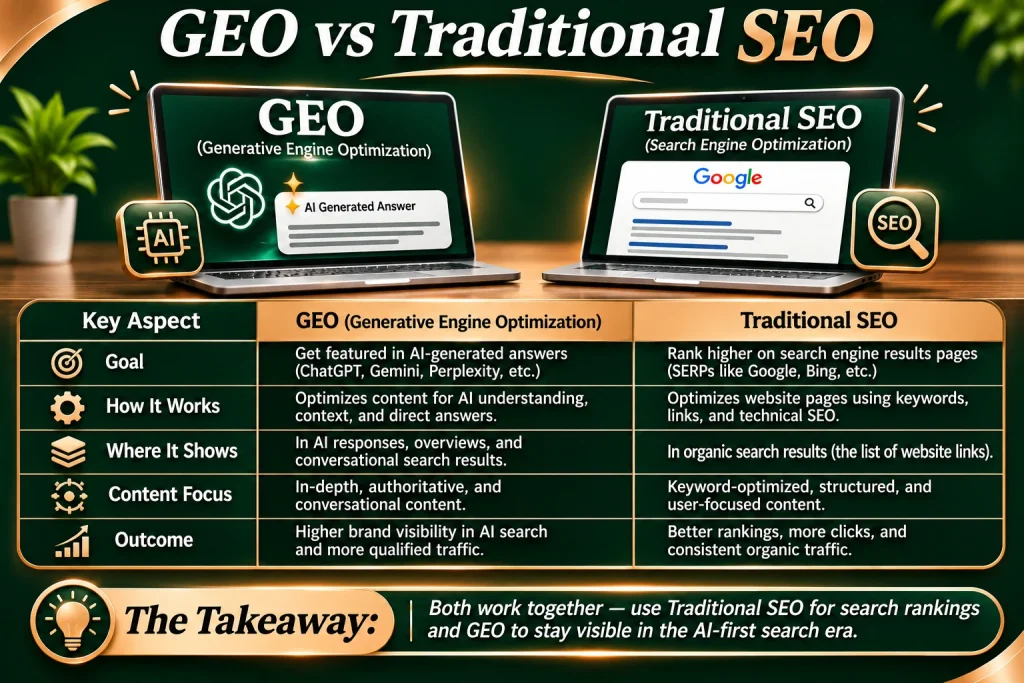
The side people find information online is changing faster than ever. For over twenty years, the playbook for digital marketing was straightforward: you optimized your website for Traditional Search Engine Optimization (SEO), climbed to the top of Google, and watched the traffic roll in.
But things look very different now. With the explosion of AI platforms like ChatGPT, Perplexity, Claude, and Google’s AI Overviews, a brand-new playbook has emerged: Generative Engine Optimization (GEO).
For marketers and business owners, the challenge is no longer just about beating a competitor for the number one spot on a list of links. The new challenge is making sure that when a user asks an AI engine a question, the AI trusts, selects, and recommends your brand in its answer.
In this guide, we will break down the real differences between GEO and traditional SEO in plain English. You will learn how these two worlds fit together and how to adapt your content strategy so your business stays visible, no matter how people choose to search
What are we actually talking about?
Before we look at how to optimize for these changes, let’s define exactly what these two approaches mean for your business.
Traditional SEO is all about optimizing your website’s code, structure, and content so search engines like Google Search and Microsoft Bing can easily find and rank your pages.
The main goal here is to rank your specific URLs as high as possible on the search results page. You want users to see your link, click it, and land directly on your website.
GEO is a newer strategy. It focuses on organizing and formatting the information on your website so that Large Language Models (LLMs) can easily read, understand, and use it inside their AI-generated answers.
With GEO, you aren’t chasing a traditional ranking position. Instead, you are aiming to be the trusted source that the AI cites and links to when answering a user’s conversational prompt.
Key Differences at a Glance
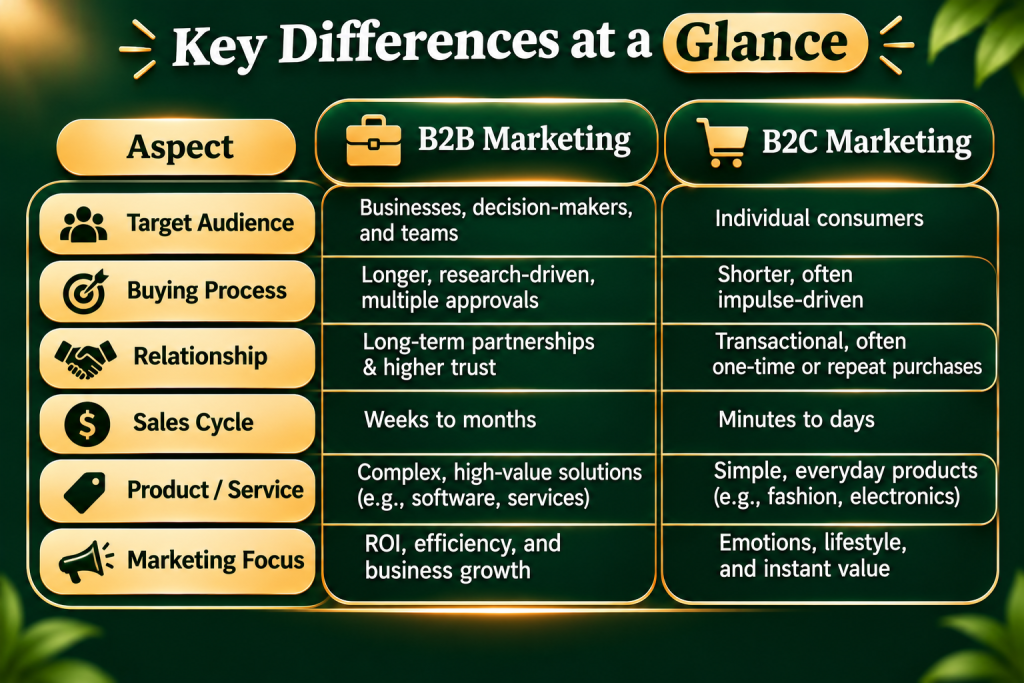
• The Core Systems: Traditional SEO targets search engines that sort links, while GEO targets AI systems that synthesize multiple websites into a single answer.
• Target Platforms: Traditional SEO runs on Google Search and Microsoft Bing, whereas GEO focuses on ChatGPT, Perplexity, and Google AI Overviews.
• The Main Goal: Traditional SEO aims for high rank positions to drive direct website traffic, while GEO works to secure brand mentions and citation links inside AI summaries.
• Content Styling: Traditional SEO uses keyword-optimized long-form articles, while GEO relies on direct, fact-heavy answers and highly structured data modules.
• Authority Signals: Traditional SEO builds authority via external backlinks, while GEO demands cross-platform brand consistency and verified expert quotes.
• Success Metrics: Traditional SEO tracks organic clicks and impressions using tools like Semrush or Ahrefs, while GEO evaluates your Share of Voice inside AI answer interfaces.
• User Interaction: Traditional SEO forces users to scroll and click through blue links, while GEO serves the user a single conversational response instantly.
How AI Search Works Behind the Scenes
To understand GEO, you need to understand a concept called Retrieval-Augmented Generation (RAG). Don’t let the technical name scare you—the process is actually quite simple.
When a user types a detailed question into an AI search engine, the system follows three basic steps:
1. The Search (Retrieval): The AI instantly scans the web to pull a handful of the best articles and pages related to the question.
2. The Filter (Evaluation): The AI reads these pages, filtering out fluff and looking for hard facts, clear structure, and trusted sources.
3. The Answer (Synthesis): The AI blends the information from those different websites into one smooth response, adding little clickable citations that link back to the sources it used.
If your content is full of fluff and lacks clear facts, the AI will simply skip your page and pull data from a competitor who got straight to the point.
How to Keep Winning at Traditional SEO
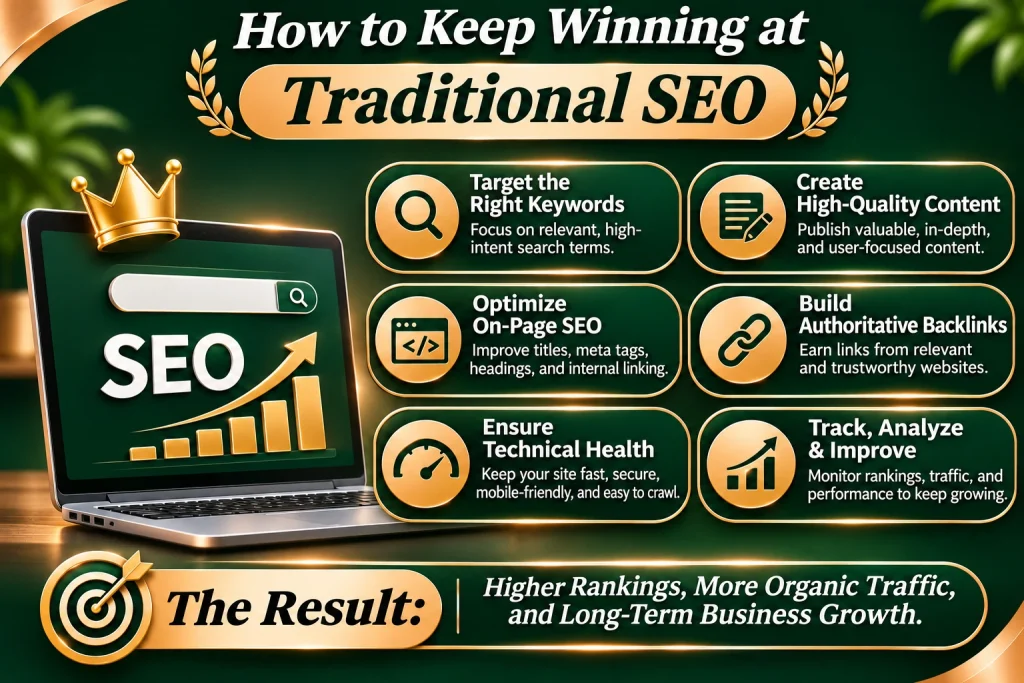
Traditional SEO is definitely not dead. In fact, AI engines usually pull their sources from websites that already rank well in traditional search. To keep your foundational SEO strong, focus on these core areas:
• Understand User Intent: Don’t just target keywords because they have high search volume. Write content that directly answers what the user is looking for, whether they want to buy something or just learn how it works. Tools like Semrush and Ahrefs are great for finding these opportunities.
• Smart On-Page Setup: Keep using your main keywords naturally in your titles, headings, and body copy. Write helpful alt text for your images and clean up duplicate content.
• Fix Technical Issues: Make sure your website loads quickly on mobile phones, uses secure HTTPS, and has a clean sitemap submitted via Google Search Console.
• Build Real Authority: Focus on earning high-quality backlinks from respected, relevant websites in your industry.
How to Optimize Your Content for GEO
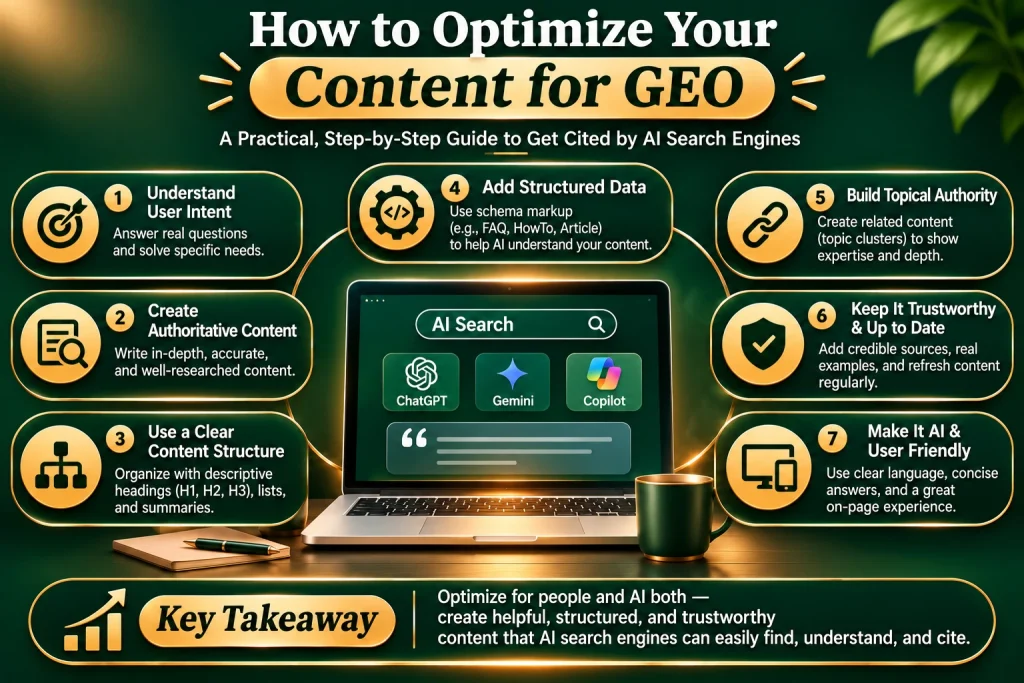
Optimizing for AI engines means making your content incredibly easy for a machine to read, verify, and quote. Recent industry studies show that making a few strategic tweaks to your writing can massively increase the chances of an AI quoting your website:
AI models love text that gets straight to the point. Avoid corporate jargon or beating around the bush.
Data adds instant credibility. Studies show that including exact percentages, numbers, and verified data points can boost your visibility in AI search by up to 30%.
“According to our 2026 internal benchmarking report, our platform reduces project turnaround times by exactly 38% within the first month.”
AI engines place a high value on true expertise. Adding direct, meaningful quotes from named specialists in your company can increase your AI citation rates by up to 41%. Make sure to include the expert’s full name and job title so the AI can verify who they are.
Schema markup is behind-the-scenes code that tells search engines exactly what your content means. Using specific schema tags—like Product, Organization, FAQPage, and Author—acts like a translator for AI crawlers, helping them perfectly understand your data.
Traditional search looks at links. AI looks at your entire digital footprint. Make sure your business name, address, services, and core details are identical across your website, social media profiles, press releases, and major business directories.
Frequently Asked Questions

No. GEO is an addition to traditional SEO, not a replacement. Regular search engines still drive massive amounts of traffic every day. Plus, AI tools rely on traditional search indexes to find their data in the first place, so you still need a strong SEO foundation.
Instead of just looking at clicks and organic traffic, you will want to track how often your brand is mentioned in AI answers, your Share of Voice (how often you appear compared to competitors in AI tools), and whether your direct, branded search volume is growing.
Any industry where users ask a lot of questions or research options before buying. This includes e-commerce brands looking to land in AI shopping guides, professional services, real estate, and companies providing educational content in finance or healthcare.
Absolutely not. Keyword stuffing actually hurts your chances. AI models use natural language processing to read like a human. They care about readability, clear formatting, and solid facts—not how many times you typed a specific phrase.