SEO

SEO

What is Programmatic SEO

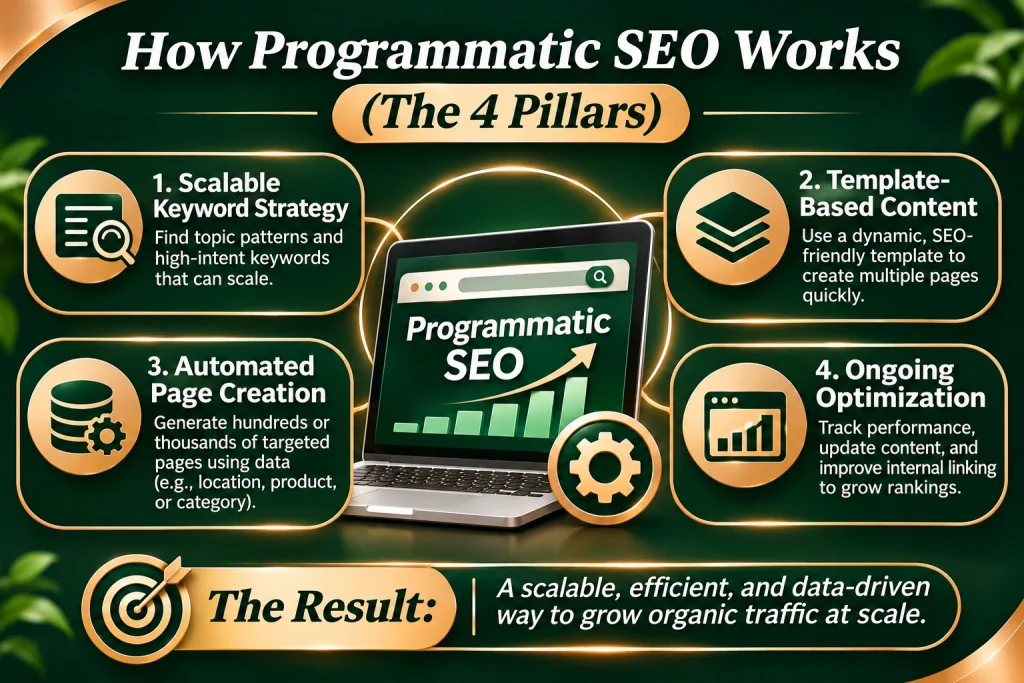
The Ultimate Guide to Programmatic SEO  Imagine creating 1,000 high-quality, targeted landing pages on your website in just a few days. Sounds completely impossible, right? With traditional content creation, it definitely is. But with Programmatic SEO (pSEO), it is not only possible, but it is also one of the most powerful digital marketing strategies used to dominate search engine results pages (SERPs).If you want to scale your organic traffic exponentially without hiring an army of writers or losing your mind over manual content creation, this comprehensive guide is tailored for you Programmatic SEO is the strategic practice of addressing search intent at scale by publishing thousands of landing pages using a database, a dynamic template, and automation.Instead of writing every single article or landing page completely from scratch, you build an automated or semi-automated system. This system injects structured data into highly optimized templates to generate unique pages based on specific user search patterns A Real-World Example Think of global platforms like Tripadvisor or Yelp. Their marketing teams do not manually sit down to write a fresh blog post for “Best Hotels in Paris,” “Best Hotels in New York,” and “Best Hotels in Tokyo.”Instead, they leverage an architectural approach:• A massive central database filled with hotel information, ratings, and city names.• A single, masterfully designed webpage template.• An automated code setup that merges the two, creating millions of search-optimized pages instantly Traditional SEO vs. Programmatic SEO While both approaches have the exact same goal—getting your website to the top of Google—the way you execute them is completely different. Here is how they stack up against each other: Content Creation • Traditional SEO: Manual process where human writers draft every single piece one by one.• Programmatic SEO: Fully automated setup using database rows and smart page templates. Keywords Targeted • Traditional SEO: High-volume, highly competitive short phrases that take months to rank for.• Programmatic SEO: Low-volume, hyper-specific long-tail phrases that bring ready-to-buy visitors. Speed to Scale • Traditional SEO: Slow and linear progress, typically averaging just a few posts every week.• Programmatic SEO: Fast and exponential growth with thousands of helpful pages launched instantly. Core Focus • Traditional SEO: In-depth storytelling, personal opinions, and editorial brand essays.• Programmatic SEO: Data-driven layouts, quick structural answers, and instant user utility. How Programmatic SEO Works (The 4 Pillars) Building a successful pSEO setup isn’t magic; it comes down to getting four simple steps right: 1. Finding Your Keyword Pattern Programmatic SEO relies entirely on keyword modifiers. You are looking for a core head term combined with specific variables that repeat over and over.• Head Term: “Best CRM software for…”• The Result: 3 unique, highly targeted search terms generated from a single core idea. 2 Gathering the Data Once you know your pattern, you need high-quality data to fill those pages. Your database is the heart of your content. You can get this data by:• Using public APIs or trusted government data sources.• Ethically collecting or scraping public web data.• Using your own internal data or user reviews. 3. Designing a Helpful Template Next, you need to build a single webpage template designed to give the searcher exactly what they want. This template uses placeholders where your database information will automatically drop in (like {Software_Name}, {Pricing}, or {Key_Features}). A great template uses comparison tables and simple charts so the visitor can scan the page and get answers instantly. 4. Setting up the Automation Stack Thanks to modern no-code tools, you don’t even need to be a programmer to do this. You can store your data in Airtable, use a syncing tool like Whalesync, and connect it to a website platform like Webflow or WordPress to publish your pages automatically. Real Brands Dominating with SEO You probably interact with programmatic pages every day without realizing it. Here are a few great examples: • Zapier: They mapped out a massive directory connecting thousands of apps. By automating pages for every single combination (like “How to connect Slack with Asana”), they built over 50,000 highly targeted landing pages that bring in millions of visitors a month. • Canva: They created specific landing pages for every type of design template you could think of. When you search for “Free Instagram Story Template for Fitness”, Google sends you straight to a custom Canva page built just for that search. • Nomad List: They gathered public data on safety, cost of living, and internet speeds for cities all over the world. They turned that raw data into thousands of automated city profile pages specifically targeting digital nomads. Conclusion Programmatic SEO changes the game because it shifts your focus from writing articles to building smart data systems. By finding repeatable keyword patterns and pairing them with clean, helpful layouts, you build a traffic machine that works for you 24/7. Find your data angle, design your layout, and start scaling. Frequently Asked Questions 1. Does Google penalize programmatic SEO pages? No. Google doesn’t care whether your page was generated by a script or written line-by-line by a human. Google only cares if the page is helpful. If your pages provide great data, a solid layout, and truly answer the searcher’s question, they will rank well. 2. Do I need to know how to code? Not anymore. With the rise of no-code tools, you can easily link an Airtable database straight to a WordPress or Webflow site using basic plugins. You can launch a massive pSEO project without writing a single line of code. 3. How many pages should I publish first? Always start small. Launch a test batch of 50 to 200 pages. Give Google a few weeks to crawl and index them. Once you see that they are indexing properly and look great to real users, go ahead and publish the rest of your database. 4. What is the difference between a head term and a modifier? The head term is the core topic you are targeting (e.g., “Developer jobs”). The modifier is the variable that changes to create long-tail variations
SEO

Multi-Model SEO

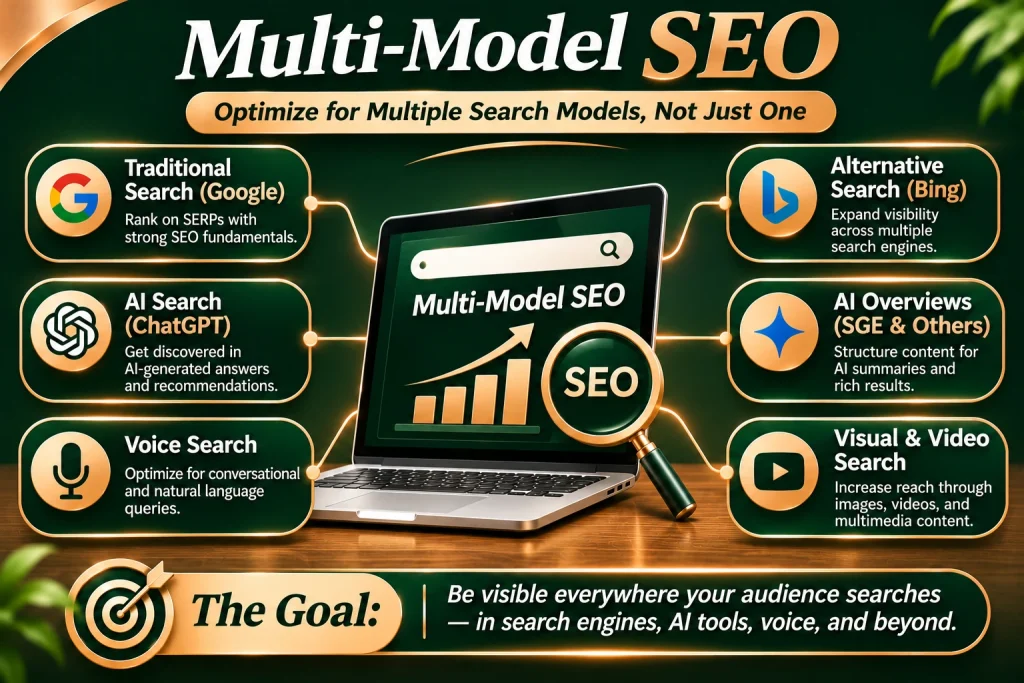
Multi-Model SEO The landscape of search engine optimization is undergoing its most radical transformation since the inception of the internet. For over two decades, the formula for online visibility was straightforward: write content, insert keywords, build backlinks, and please the Google algorithm. If you did this right, you landed on the coveted first page of Google’s blue links.Today, that playbook is no longer enough.We have entered the era of the Generative AI Search. Millions of internet users are bypassing traditional search bars entirely. Instead, they are turning to conversational AI platforms like ChatGPT, Google Gemini, Microsoft Copilot, Apple Intelligence, and Perplexity AI to find information, compare products, and solve problems.To survive and thrive in this new digital ecosystem, you need to transition from traditional SEO to Multi-Model SEO (also known as LLMO or Large Language Model Optimization). This ultimate guide will break down exactly what Multi-Model SEO is, why it matters, and how you can optimize your website to rank across every major AI engine and traditional search platform. What is Multi-Model SEO? Multi-Model SEO is the practice of optimizing your digital content so that it can be easily crawled, understood, synthesized, and cited by multiple types of search engines—specifically traditional algorithmic search engines (like Google and Bing) and Generative AI Large Language Models (like OpenAI’s GPT-4, Anthropic’s Claude, and Google’s Gemini).The term “Multi-Model” refers to the diverse ecosystem of AI models that power modern search. Instead of optimizing for just one master algorithm (Google’s PageRank variants), you are now optimizing for systems that process natural language, images, voice commands, and complex reasoning patterns simultaneously.The Shift from Keywords to Vector EmbeddingsTraditional search relies heavily on keyword matching. If someone typed “best running shoes,” Google looked for pages containing that exact phrase or close variations.AI models operate on Vector Search and Semantic Understandings. They convert your content into mathematical vectors to grasp the deeper context, intent, and relationships between concepts. Therefore, Multi-Model SEO focuses less on how many times you repeat a keyword and more on the depth, accuracy, and structure of your information. Why You Must Adapt to Multi-Model SEO Today If your traffic relies entirely on traditional search clicks, your business is at risk. Here is why adopting a multi-model approach is urgent: • The Rise of Zero-Click Searches: AI engines generate direct answers right on the search results page (like Google’s AI Overviews). Users get the answer they need without ever clicking through to a website.• AI Search as the New Gatekeeper: Tools like Perplexity and ChatGPT act as personalized research assistants. If your website isn’t cited in their responses, you lose out on a massive, highly qualified audience.• Voice and Visual Search Expansion: Multi-model AI systems seamlessly integrate voice inputs and image uploads. Your text content must be optimized to align with how people talk and what they see, not just what they type. The Core Framework of Multi-Model SEO To build an effective Multi-Model SEO strategy, you must understand the four pillars of how modern AI models evaluate and recommend content. 1. Data Infrastructure & Machine Readability Before an AI model can recommend your content, its underlying web scraper (like GPTBot or Google-Extended) must be able to parse your site cleanly. Clean code, fast loading speeds, and robust schema data act as the foundation. 2. Semantic Authority AI models prioritize deep data over superficial summaries. You must cover topics exhaustively, answering primary, secondary, and tertiary user queries within a single cohesive content hub. 3. Reputation and Brand Footprint LLMs are trained on massive datasets containing books, news articles, forums, and academic papers. If your brand or authors are mentioned positively across multiple third-party platforms, AI engines treat your site as an authoritative source. 4. User Experience & Learning to Rank (LTR) Both AI engines and traditional algorithms look at user signals. If a user follows a link from ChatGPT to your site and immediately leaves because the page is cluttered or hard to read, the AI learns that your site is a poor recommendation. Traditional SEO vs. Multi-Model SEO: A Direct Comparison To succeed in this hybrid landscape, you need to understand how traditional search optimization differs from modern AI optimization. Both are important, but they require different focuses: • Primary Target: Traditional SEO targets Google and Bing algorithmic crawlers, while Multi-Model SEO focuses on LLMs, Vector Databases, and Chat Interfaces.• Keyword Strategy: Traditional SEO relies on strict keyword density and search volume focus, whereas Multi-Model SEO uses semantic clusters, entities, and conversational intent.• Content Goal: Traditional SEO aims for a high click-through rate (CTR) from SERPs, while Multi-Model SEO strives for inclusion in AI summaries and direct citations.• Formatting: Traditional SEO uses standard H1, H2, H3 tags with long-form text, whereas Multi-Model SEO utilizes bulleted data fragments, definition lists, and structured tables.• Success Metric: Traditional SEO measures organic keyword rankings and organic traffic, while Multi-Model SEO tracks Share of Model Voice (SoMV) and citation traffic Frequently Asked Questions Q1 What is the difference between Google SEO and ChatGPT Optimization? Google SEO focuses on optimizing for traditional ranking factors like backlinks, core web vitals, and algorithmic keyword matching to earn clicks on a web page. ChatGPT Optimization (LLMO) focuses on semantic clarity, conversational context, structured data, and building a broad digital brand footprint so that the AI model references and cites your brand within its conversational responses. Q2 Will Multi-Model SEO replace traditional SEO entirely? No, Multi-Model SEO expands upon traditional SEO. Traditional search engines like Google still drive massive amounts of traffic, but they are integrating AI features into their core interfaces. Doing Multi-Model SEO ensures your site ranks well in traditional search results while simultaneously qualifying you for selection in AI-generated answers and voice searches. Q3 How do I know if my website is ranking or cited in AI search engines? A you can track your AI visibility by manually testing high-intent conversational queries related to your niche inside ChatGPT Search, Gemini, and Perplexity to see if your site is cited. Additionally, modern

SEO

Local SEO for Small Businesses

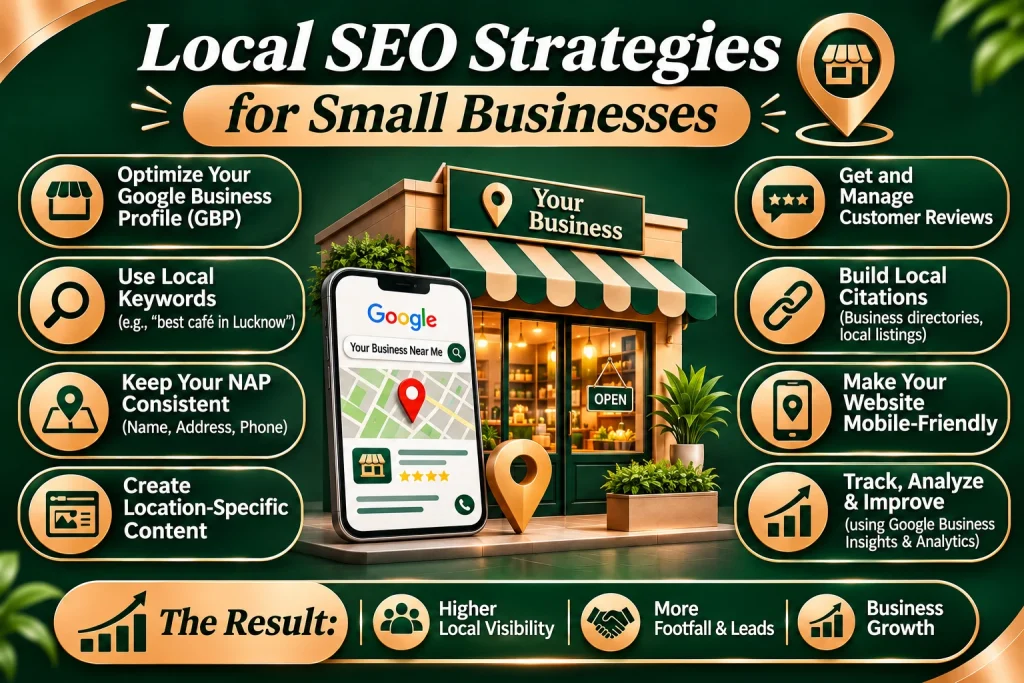
Local SEO Strategies for Small Businesses If you run a small business, you already know that your local community is the backbone of your success. Whether you are running a cozy neighborhood coffee shop, managing a fast-moving roofing crew, or styling customers at a local boutique, you need a reliable way to get noticed. You need to be the business that pops up when someone nearby is looking for exactly what you offer.That is where Local Search Engine Optimization (Local SEO) comes into play.Think about it: when people want to find a service, buy a product, or grab a bite, they pull out their phones and search. Nearly half of all Google searches have “local intent.” Even better, the vast majority of people who do a local search end up walking through a physical storefront within 24 hours. If your business isn’t showing up in those moments, you are essentially handing your hard-earned customers over to your competitors.Let’s break down exactly how you can fix that. This guide will walk you through easy, realistic local SEO strategies that will rank your business higher, win more clicks, and turn online searches into real-world handshakes. What on Earth is Local SEO anyway? At its core, local SEO is just the process of making your business visible to people searching in your immediate geographic area. It is why a search for “best tacos” yields results down the street from where you are sitting, rather than a top-tier restaurant three states away.While these searches happen on Google all day long, they also happen on map apps like Google Maps and Apple Maps.Why You Want to Win the “Map Pack”When you type something like “plumber near me” into Google, you’ll notice a distinct box at the top of the page. It features a map and showcases three local business profiles. In the SEO world, we call this the Google Local Map Pack.Getting into this top three spot is your ultimate goal. Why? Because it captures nearly half of all the clicks on the page. It completely bypasses the regular website listings below it. If you can get your business featured here, your phone will start ringing. Claim and Polish Your Google Business Profile If you only have time to do one thing from this list, make it this one. Your Google Business Profile (GBP)—which you might remember as Google My Business—is your absolute most important asset. It is essentially your digital storefront across Google Search and Maps, and it won’t cost you a single cent. How to set it up for success: • Claim and Verify It: Head over to the Google Business Profile site, claim your company, and complete the verification steps. Usually, Google will send you a text, give you a quick call, or ask for a brief video verification of your workspace. • Keep Your Details Identical: Your business Name, Address, and Phone number (NAP) need to be perfectly consistent everywhere. If your website says “Main Street,” don’t type “Main St.” on your Google profile. Keep it matching perfectly so search engines don’t get confused. • Pick the Right Categories: Be specific. If you run an Italian restaurant, don’t just pick “Restaurant.” Choose “Italian Restaurant” as your primary category, and add secondary categories to cover the rest of your menu. • Write a Real Description: You have 750 characters to introduce yourself. Tell a brief story about who you are, what makes you different, and naturally mention the city or town you serve. Don’t just stuff keywords here; write it for a human. • Post Updates Regularly: Treat your profile a bit like a social media page. Drop a post when you have a weekend sale, a new menu item, or an upcoming event. Active profiles tell Google that your business is alive and well. • Show Off with Photos: Upload clear, bright photos of your team, the inside of your store, your products, or your workspace. Businesses with great photos get significantly more requests for driving directions than those without. Find Keywords That Actually Mean Business Keyword research for local businesses isn’t about chasing millions of views. It is about finding the exact phrases your actual customers type in when they are ready to pull out their wallets. Keep it simple with these tactics: • The Service + Location Formula: Start with the basics. Think phrases like “HVAC repair Austin” or “dental clinic downtown Miami”.• Think Like a Customer: People rarely search for corporate industry jargon. • Snoop on Your Competitors: Go look at the businesses currently winning the Map Pack in your area. Look at their websites and profiles. What phrases are they using in their main titles? Don’t copy them blindly, but use their success as a blueprinth Make Your Website Speak “Local” Once you know your local keywords, you need to place them naturally across your website. If your business serves multiple distinct cities or neighborhoods, don’t try to cram them all onto your homepage. Instead, build a clean, dedicated landing page for each specific location. Your Quick On-Page Checklist  • Title Tags: This is the clickable headline that appears in search results. Put your main local keyword right at the beginning. Keep it under 60 characters so it doesn’t get cut        off.• Good Example: Affordable Web Design Chicago  • Meta Descriptions: This is the short summary paragraph below your title. Make it inviting and clear. Tell the reader exactly what to do next.• Good Example: Need reliable web design in Chicago? We build fast, mobile-friendly sites that bring in real customers. Get your free custom quote today! • Headings (H1, H2): Your main page title (the H1) should include your city name. Use your subheadings (H2s) to break down specific services or neighborhoods you cover.  • Drop a Map in the Footer: Go to Google Maps, copy your official listing’s embed code, and paste it directly into your website’s footer or contact page. It is a massive, clear         signal to Google confirming your physical

SEO

GEO vs Traditional SEO

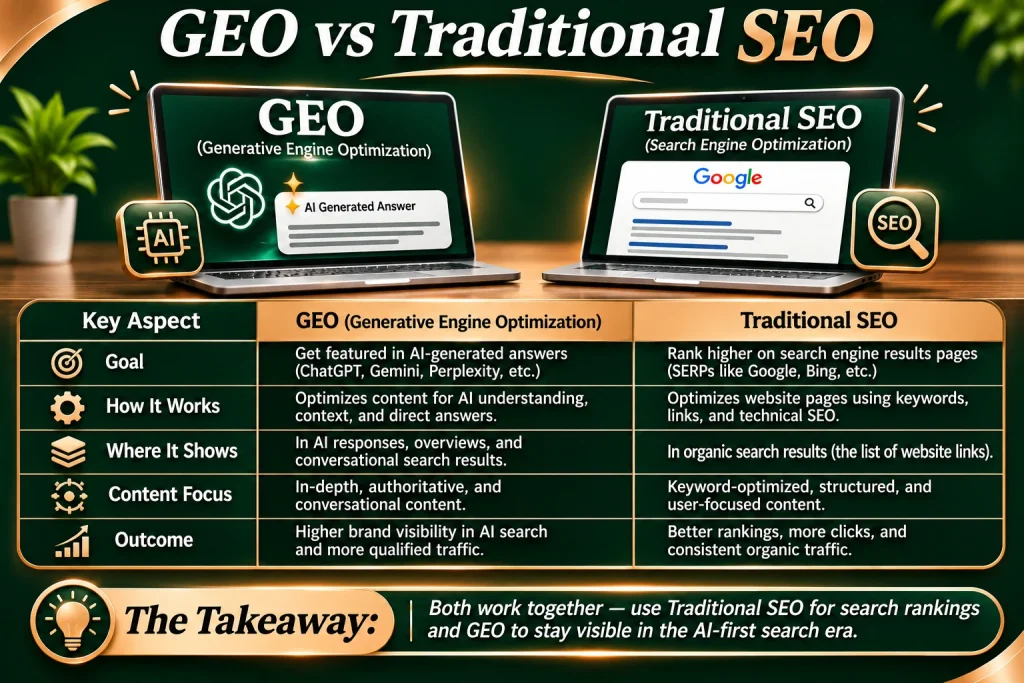
GEO vs Traditional SEO The side people find information online is changing faster than ever. For over twenty years, the playbook for digital marketing was straightforward: you optimized your website for Traditional Search Engine Optimization (SEO), climbed to the top of Google, and watched the traffic roll in.But things look very different now. With the explosion of AI platforms like ChatGPT, Perplexity, Claude, and Google’s AI Overviews, a brand-new playbook has emerged: Generative Engine Optimization (GEO).For marketers and business owners, the challenge is no longer just about beating a competitor for the number one spot on a list of links. The new challenge is making sure that when a user asks an AI engine a question, the AI trusts, selects, and recommends your brand in its answer.In this guide, we will break down the real differences between GEO and traditional SEO in plain English. You will learn how these two worlds fit together and how to adapt your content strategy so your business stays visible, no matter how people choose to search What are we actually talking about? Before we look at how to optimize for these changes, let’s define exactly what these two approaches mean for your business. What is Traditional SEO? Traditional SEO is all about optimizing your website’s code, structure, and content so search engines like Google Search and Microsoft Bing can easily find and rank your pages.The main goal here is to rank your specific URLs as high as possible on the search results page. You want users to see your link, click it, and land directly on your website. What is Generative Engine Optimization (GEO)? GEO is a newer strategy. It focuses on organizing and formatting the information on your website so that Large Language Models (LLMs) can easily read, understand, and use it inside their AI-generated answers.With GEO, you aren’t chasing a traditional ranking position. Instead, you are aiming to be the trusted source that the AI cites and links to when answering a user’s conversational prompt. Key Differences at a Glance • The Core Systems: Traditional SEO targets search engines that sort links, while GEO targets AI systems that synthesize multiple websites into a single answer.• Target Platforms: Traditional SEO runs on Google Search and Microsoft Bing, whereas GEO focuses on ChatGPT, Perplexity, and Google AI Overviews.• The Main Goal: Traditional SEO aims for high rank positions to drive direct website traffic, while GEO works to secure brand mentions and citation links inside AI summaries.• Content Styling: Traditional SEO uses keyword-optimized long-form articles, while GEO relies on direct, fact-heavy answers and highly structured data modules.• Authority Signals: Traditional SEO builds authority via external backlinks, while GEO demands cross-platform brand consistency and verified expert quotes.• Success Metrics: Traditional SEO tracks organic clicks and impressions using tools like Semrush or Ahrefs, while GEO evaluates your Share of Voice inside AI answer interfaces.• User Interaction: Traditional SEO forces users to scroll and click through blue links, while GEO serves the user a single conversational response instantly. How AI Search Works Behind the Scenes To understand GEO, you need to understand a concept called Retrieval-Augmented Generation (RAG). Don’t let the technical name scare you—the process is actually quite simple. When a user types a detailed question into an AI search engine, the system follows three basic steps:1. The Search (Retrieval): The AI instantly scans the web to pull a handful of the best articles and pages related to the question.2. The Filter (Evaluation): The AI reads these pages, filtering out fluff and looking for hard facts, clear structure, and trusted sources.3. The Answer (Synthesis): The AI blends the information from those different websites into one smooth response, adding little clickable citations that link back to the sources it used.If your content is full of fluff and lacks clear facts, the AI will simply skip your page and pull data from a competitor who got straight to the point. How to Keep Winning at Traditional SEO Traditional SEO is definitely not dead. In fact, AI engines usually pull their sources from websites that already rank well in traditional search. To keep your foundational SEO strong, focus on these core areas: • Understand User Intent: Don’t just target keywords because they have high search volume. Write content that directly answers what the user is looking for, whether they want to buy something or just learn how it works. Tools like Semrush and Ahrefs are great for finding these opportunities.• Smart On-Page Setup: Keep using your main keywords naturally in your titles, headings, and body copy. Write helpful alt text for your images and clean up duplicate content.• Fix Technical Issues: Make sure your website loads quickly on mobile phones, uses secure HTTPS, and has a clean sitemap submitted via Google Search Console.• Build Real Authority: Focus on earning high-quality backlinks from respected, relevant websites in your industry. How to Optimize Your Content for GEO Optimizing for AI engines means making your content incredibly easy for a machine to read, verify, and quote. Recent industry studies show that making a few strategic tweaks to your writing can massively increase the chances of an AI quoting your website: Give Direct, Fact-Dense Answers AI models love text that gets straight to the point. Avoid corporate jargon or beating around the bush. Include Clear Data and Statistics Data adds instant credibility. Studies show that including exact percentages, numbers, and verified data points can boost your visibility in AI search by up to 30%.“According to our 2026 internal benchmarking report, our platform reduces project turnaround times by exactly 38% within the first month.” Feature Real Expert Insights AI engines place a high value on true expertise. Adding direct, meaningful quotes from named specialists in your company can increase your AI citation rates by up to 41%. Make sure to include the expert’s full name and job title so the AI can verify who they are. Use Advanced Schema Markup Schema markup is behind-the-scenes code that tells search engines exactly what your content means.

SEO

AI SEO & AEO

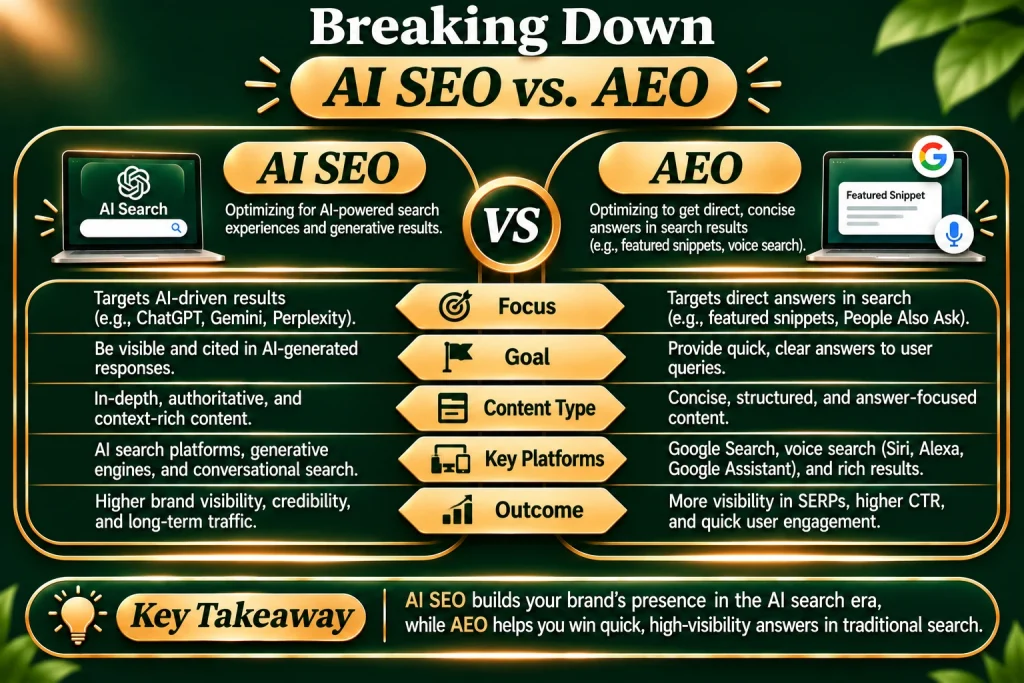
The Word-Matching Days (1998–2012) Aerly search engines were incredibly literal. If someone typed “best running shoes,” the algorithm simply looked for the page that repeated that exact phrase the most times. It was clunky, easy to game with keyword stuffing, and resulted in terrible user experiences The Intent Era (2013–2022) Google got smarter with updates like RankBrain and BERT. Search shifted from matching literal words to understanding human intent. Google built its Knowledge Graph to understand how real-world entities (people, places, and brands) connect. It started answering what you meant, not just what you typed. The Generative Answer Era (2023–Present) Today, search is fully cognitive. Generative engines don’t just hand over a list of websites; they read the web in real-time, mix data from multiple sources on the fly, and write a custom paragraph specifically for the user. Breaking Down AI SEO vs. AEO While both strategies aim to get your brand noticed, they require very different approaches behind the scenes. Think of AI SEO as optimizing your entire house for modern visitors, while AEO is making sure the front door is completely wide open for AI delivery bots. he Zero-Click Reality Over 60% of searches now result in zero clicks because search and answer engines solve the query instantly on-page. This means traffic volume metrics will naturally shift. Instead of chasing millions of low-intent clicks, AEO targets hyper-specific, high-intent leads who read your brand’s name cited as the absolute authority inside an AI window. Making Your Site Easy for AI Bots to Crawl If an AI chatbot’s scraper hits a wall on your site, your content cannot be read. Let’s fix the technical issues that keep your site hidden from large language models. Give the Bots Permission Some website owners block AI scrapers completely out of fear. But if you want free traffic from tools like SearchGPT or Perplexity, you need to invite their crawlers in. Check your robots.txt file and make sure you are not accidentally blocking these critical search agents: Ditch the Heavy JavaScript Delays AI bots are built for speed. If your most valuable information, pricing numbers, or core answers are locked behind complex, slow-loading JavaScript, the bot will get tired of waiting and move on to a competitor’s page. Use Server-Side Rendering (SSR) to serve clean, static HTML that bots can read instantly. Translate Your Data with Schema Markup Schema markup is basically an explicit cheat-sheet for artificial intelligence. By adding simple JSON-LD code blocks to your pages, you tell the machine exactly what your data represents. Focus heavily on three core types:• Product Schema: Delivers clear prices, availability statuses, and physical specifications.• FAQ Schema: Creates direct question-to-answer matching pathways for quick generation summaries.• Organization Schema: Proves your business is real, localized, and verified across official channels Proving Your Real-World Credibility (E-E-A-T) AI engines are deeply terrified of one thing: hallucinating or sharing fake news. Because of this, their algorithms are aggressively tuned to look for real human authority. Google calls this E-E-A-T (Experience, Expertise, Authoritativeness, Trustworthiness). Share True, First-Hand Experience An AI model can summarize a textbook, but it cannot unbox a physical product, walk into a retail shop, or spend three hours troubleshooting code. Lean into what makes you human by updating your sentence styling:• Use phrases that show ownership: “During our internal product testing, our team discovered a bug when…”• Include original, real-world photos and videos of you or your team actually doing the work rather than stock imagery. Clean Up Your Digital Footprint AI tools look at the entire internet to figure out who you are. Make sure every article on your site has a real author bio linked to an active LinkedIn profile or personal portfolio. Get your team featured on podcasts, write guest columns for reputable trade sites, and participate in community forums like Reddit. The more the web connects your name to a specific topic, the more AI tools will trust your content. Writing for the Machines — The Rules of GEO If you want to drive traffic to your website today, you have to write for a dual audience. You are no longer just writing for a human reader sitting at a desk; you are writing for the Large Language Model (LLM) that reads your website and decides whether or not to recommend you. This shift has created a brand new copywriting style called Generative Engine Optimization (GEO).GEO is not about gaming an algorithm or over-complicating your sentences. It is about structuring your text so clearly that an AI model can parse your data, trust your assertions, and present your brand as the perfect solution. The Inverted Pyramid Writing Framework To get cited by tools like ChatGPT or Google AI Overviews, you must structure your content like an inverted pyramid. Put your summary at the absolute top, followed by structural explanations, and conclude with deep-dive contextual details. The 3-Part Content Block Strategy: 1. The Question Subheading: Make your H2 or H3 tags read exactly like a natural question a human would say out loud to an assistant.2. The Instant Snippet: Put a clear, direct answer in the very first sentence right under that heading. Keep it between 40 to 60 words and cut any introductory filler words.3. The Proof Layer: Immediately back up that quick answer with a bulleted list, a comparison table, or a specific qualitative data point. The 4 Types of Conversational Intent You Need to Cover When designing your content topics, ensure you create specific pieces that map to these four distinct conversational pathways: Definitional Intent (“What is…”) Users seek a crisp, clear baseline breakdown of a concept. Provide clean, definitive blocks of text without unnecessary storytelling. Comparative Intent (“X vs Y”) Users want an honest breakdown comparing options. Build comprehensive comparison tables that weigh real pros, cons, prices, and software limitations. Diagnostic Intent (“How to fix…”) Users describe a problem and expect a fix. Create numbered, step-by-step troubleshooting guides that outline an exact, actionable path forward. Attribution Intent (“Best near me”) Users

Scroll to Top