
Pillar Page & Topic Clusters
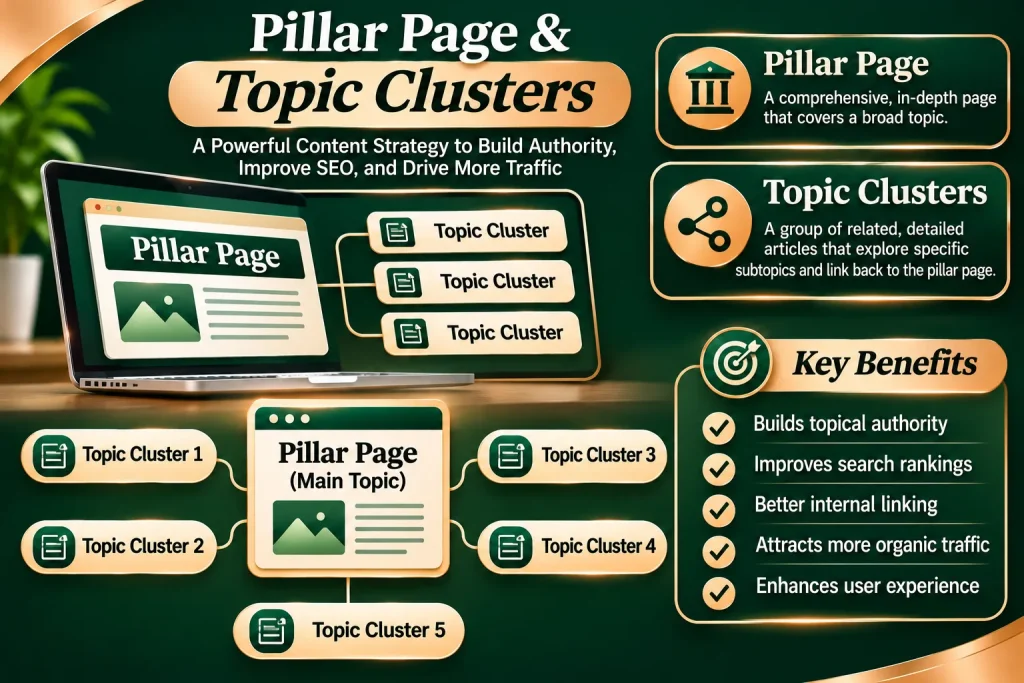
Pillar Pages and Topic Clusters: The Ultimate Strategy to Organize Your Content and Dominate Google
Have you ever wondered how some websites manage to land on the first page of Google for highly competitive keywords, while others struggle to get noticed even for long-tail search terms?
The secret isn’t just writing longer articles or building endless backlinks. The real secret lies in how you organize your website architecture.
Years ago, you could rank on Google by simply writing a single keyword-stuffed blog post. Today, search engine algorithms are incredibly smart. They no longer look at keywords in isolation. Instead, they look for Topical Authority. Google wants to see that your website is an absolute expert on a specific subject.
If your blog looks like a random collection of thoughts thrown together without a clear structure, search engines will struggle to understand your site layout. By restructuring your content around semantic hubs, you make it easy for both search engine bots and human visitors to navigate your site, resulting in higher rankings and explosive organic traffic.
What is the Pillar Page and Topic Cluster Models ?
If you throw thousands of books onto the floor without any organization, no one will find what they are looking for. However, if you organize books by genre, author, and sub- topic, navigating the library becomes effortless.
The pillar-and-cluster strategy operates exactly like an organized library, dividing your content into three interconnected components:
The Pillar Page: A comprehensive, high-level guide that covers a broad core topic inside out. It touches upon all aspects of the subject but leaves room for detailed expansion.
Topic Clusters (Sub-pages): A collection of hyper-specific, deeply researched blog posts that dive into the individual sub-topics mentioned on your main pillar page.
Internal Hyperlinks: The strategic connective tissue.When you link your articles together using this clean structural hierarchy, you pass algorithmic value (“SEO juice”) across your entire site. If one cluster post starts ranking brilliantly, it pulls the core pillar page and all surrounding sub-pages up with it
Why Google Loves Topic Clusters (The Shift to Semantic Search)
The way people search the internet has fundamentally evolved. Instead of typing fragmented keywords like “best running shoes comfort,” users now ask natural conversational questions or use voice search assistants, typing queries like, “What are the most comfortable running shoes for flat feet with high arches?”
To keep up with this humanized search behavior, Google introduced major algorithmic updates like Hummingbird and BERT, transitioning from simple keyword matching to Semantic Search.
Semantic search focuses on user intent and context. Google tries to understand the deeper meaning behind a search query.
When you deploy a topic cluster strategy, you signal to Google that your site doesn’t just have one lucky article—it offers a comprehensive ecosystem of answers. This instantly boosts your site’s perceived expertise, authoritativeness, and trustworthiness (E-E-A-T), which are the foundational building blocks of modern SEO.
Step-by-Step Guide to Creating a Winning Topic Cluster Strategy
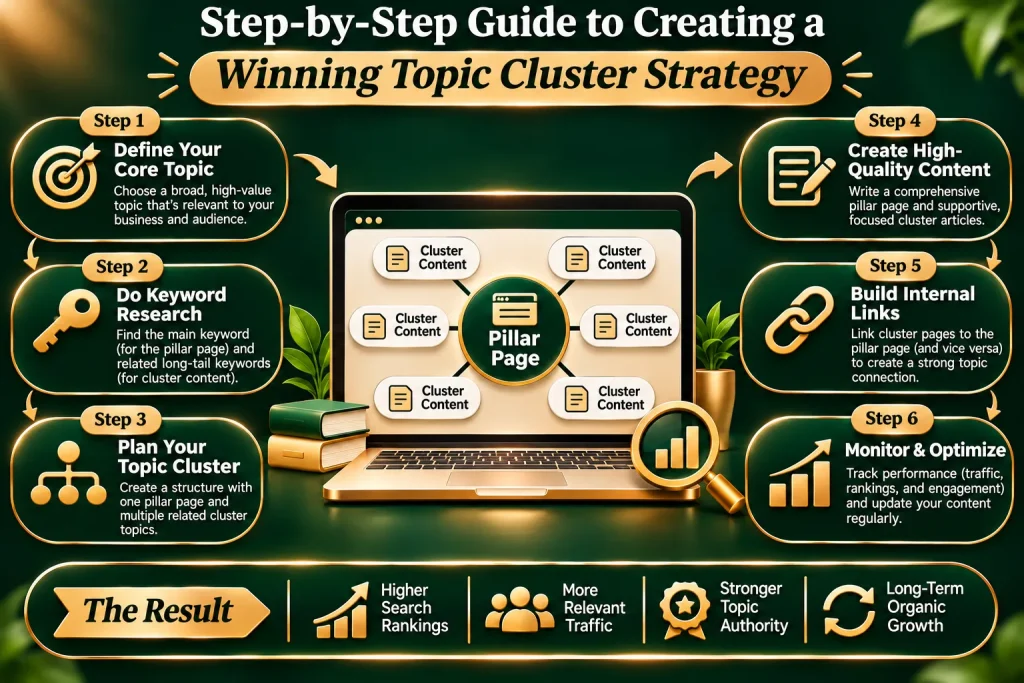
Building a topical cluster requires careful planning before you ever type a single sentence. Follow this actionable four-step framework to build your own search engine powerhouse.
Your core topic needs to be broad enough to spawn at least 8 to 20 individual blog posts, but narrow enough that it remains highly relevant to your business goals.
• Bad Example: “Digital Marketing” (Too broad; you cannot cover this effectively on one page).
• Bad Example: “How to set up a Facebook Ad pixel” (Too narrow; this is a single blog post, not a pillar).
• Great Example: “The Ultimate Guide to Social Media Marketing” (Perfect balance; allows you to branch off into specific sub-topics).
Once you have your broad pillar topic, you need to uncover the specific questions your target audience is asking. Use keyword research tools like Ahrefs or Semrush to find related long-tail search queries.
For our Social Media Marketing pillar example, your cluster keywords might look like this:
• Instagram Reels optimization strategies
• How to run LinkedIn Lead Gen forms
• A beginner’s guide to TikTok analytics
• Best times to post on social media channels
Your pillar page needs to be comprehensive, acting as the ultimate 101 guide for the chosen subject.
• Break the page down using highly descriptive header tags (H2, H3, and H4).
• Provide clear, concise overviews of each sub-topic without giving away all the fine details.
• Place an interactive table of contents right at the top of the page so users can quickly skip to the sections they care about most.
Now, write the detailed sub-pages focusing heavily on providing actionable solutions for those specific long-tail keywords.
Once written, execute the most important step: The Internal Linking Process. Inside your pillar page, find the brief summary of a sub-topic and insert an anchor link directly to the deep-dive cluster post. Conversely, inside the cluster post, make sure to include a clear link back to the main pillar page within the first few paragraphs.
3 Different Types of Pillar Pages You Can Build
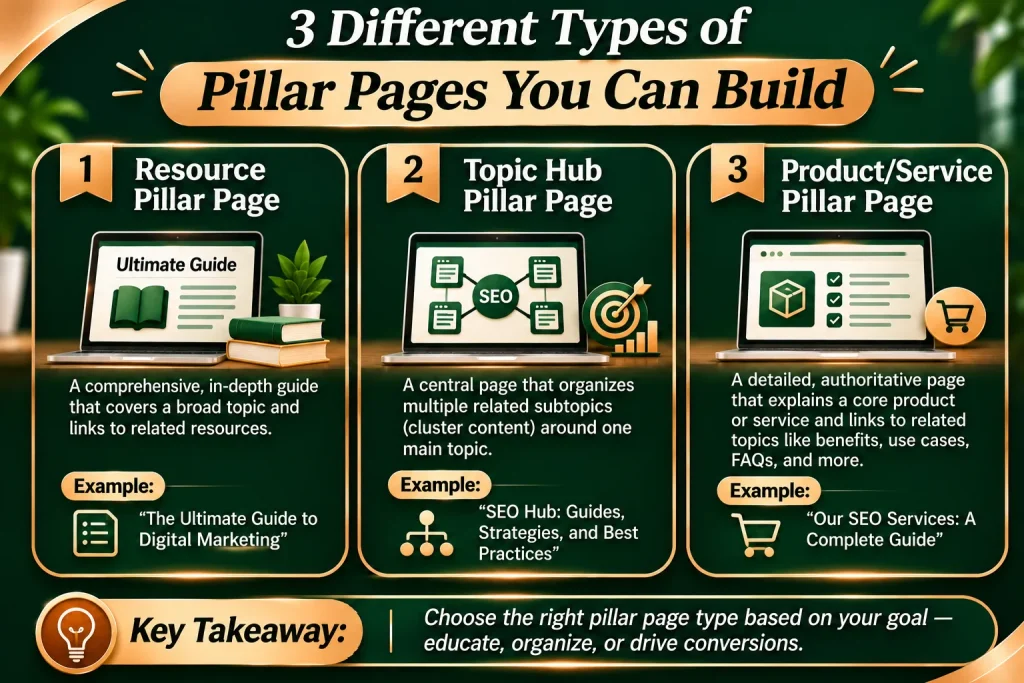
Depending on your business model and target audience, you can structure your pillar pages in a few different formats:
This operates as a curated directory of top-tier resources. It features short bookmark style descriptions of a topic alongside high-value outbound and internal links. It is designed to save users hours of search time by aggregating everything they need in one clean hub.
This is the most common format. It takes a complex subject and breaks it down into an easy-to-understand foundational textbook. It explains the What, Why, and How of a topic, serving as the ultimate starting point for beginners entering an industry.
Perfect for B2B enterprises and e-commerce brands. This page focuses on a core business offering, mapping out every possible feature, use-case, comparison, and FAQ that a buyer might need to review before feeling confident enough to make a purchase.
Best Practices for Maintaining and Optimizing Your Clusters
Once your pillar and topic clusters are live, the work isn’t quite finished. To maintain your hard-earned rankings, you must cultivate your content ecosystem continuously.
• Avoid Overlapping Intent: Make sure your cluster posts don’t accidentally compete with one another. If two sub-pages cover nearly identical solutions, merge them to avoid keyword cannibalization.
• Keep Information Up to Date: Algorithms favor fresh content. Review your pillar pages every six months to refresh statistics, repair broken links, and add references to new industry trends
.
• Track Your Internal Link Anchor Text: Do not use generic anchor text like “click here” or “read more” when connecting pages. Use descriptive, keyword-rich anchor text to help search engine crawlers understand exactly what the destination page is about.
Conclusion: Build Depth to Build Dominance
Creating a disjointed list of random blog posts is no longer a viable long-term SEO strategy. To win the battle for organic search placement, you must demonstrate undeniable topical authority.
By organizing your website around comprehensive pillar pages and tightly knit topic clusters, you deliver an exceptional user experience for your audience while showing search engines exactly why your website deserves to sit proudly at the very top of search results. Take a step back, map out your core topic hubs, and transform your website into an authoritative industry resource.
Download Your Topic Cluster Blueprint Template!
Frequently Asked Questions

Pillar pages are naturally longer than standard blog posts because they cover a wide expanse of information. While there is no strict rule, most high-ranking pillar pages sit somewhere between 3,000 to 5,000 words. Focus on being thorough and helpful rather than just trying to hit a specific word count.
Yes, absolutely. In fact, this is an excellent optimization shortcut. If you have an old, comprehensive guide that is already picking up good organic impressions, you can update it, expand the formatting, and start linking all your smaller, related blog posts directly to it to turn it into an official hub.
As a general rule of thumb, aiming for 8 to 15 cluster posts per pillar page provides a solid foundation to establish initial topical authority. You can always add more sub-pages over time as you uncover new questions or sub-topics within your industry.
While having a URL structure like /core-topic/sub-topic/ is very clean and great for user architecture, it is not strictly mandatory for SEO success. The clear, context-rich internal hyperlinks you place between the pages matter much more to search engine bots than the actual folder structure of the URLs.