Digital Marketing

Digital Marketing

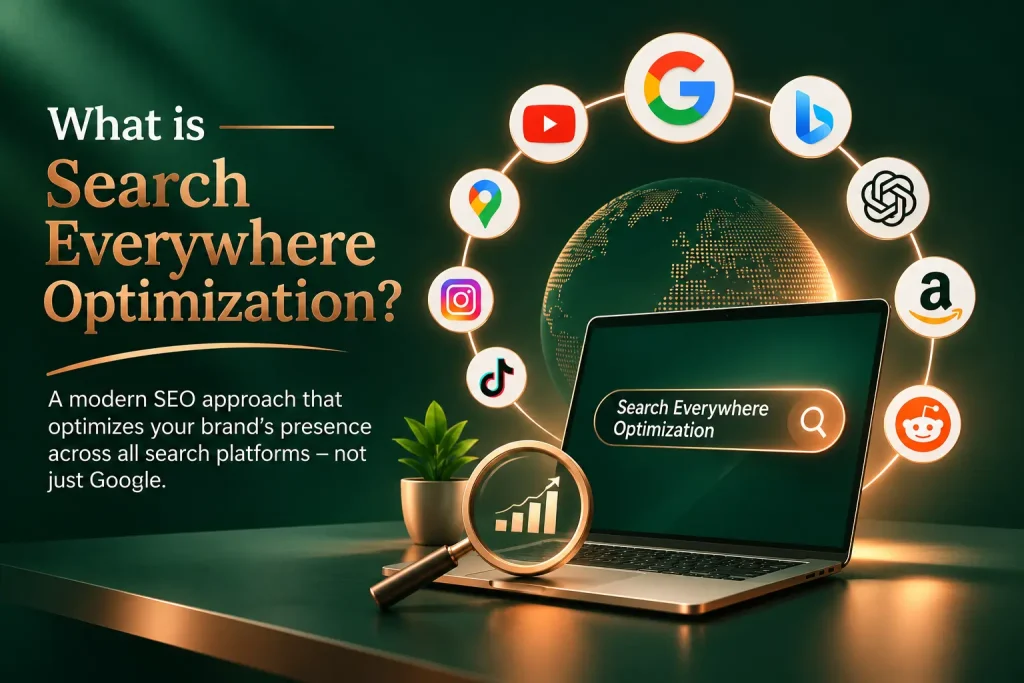
What is Search Everywhere Optimization

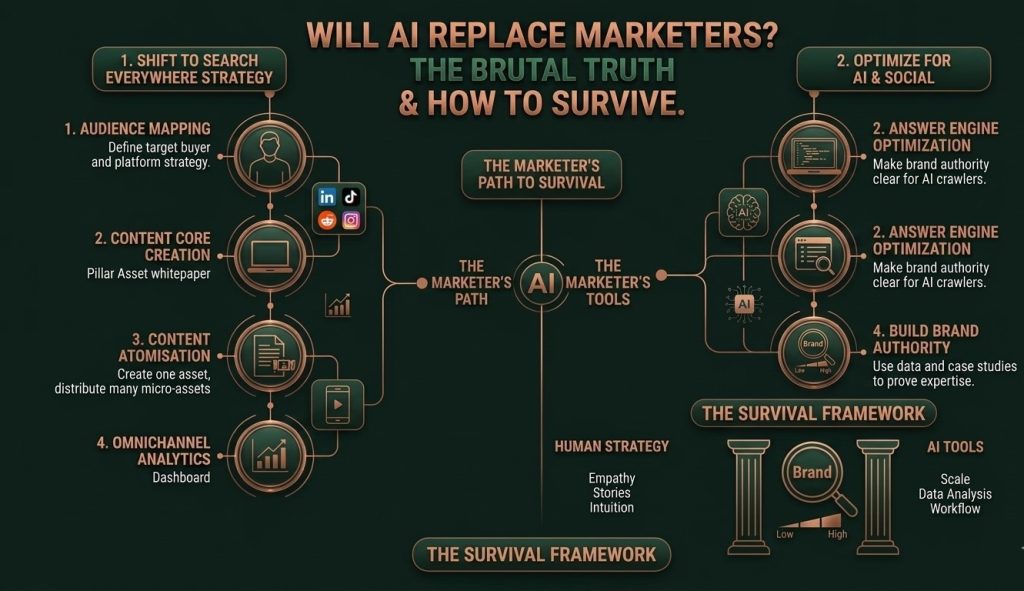
What is Search Everywhere Optimization For decades, the playbook for growing a business online was remarkably simple: if someone wanted to buy a product, hire a service, or learn something new, they “Googled it.” Your entire digital footprint depended on ranking in those ten blue links on a Google Search results page.But a massive shift in user behaviour has quietly turned the internet upside down. Today, younger generations don’t just default to a traditional search engine. If they want to find a trendy restaurant, they search on Instagram Reels or TikTok. If they want unbiased product reviews, they append “Reddit” to their query or search directly within Reddit communities. If they need a complex coding or business problem solved, they ask OpenAI ChatGPT or Perplexity AI.Because consumers are searching across multiple platforms, traditional SEO has evolved into Search Everywhere Optimization (SEO 2.0).If you are a business owner, founder, or marketer, this in-depth guide is your survival manual for the future of search. We will break down exactly how SEO 2.0 works and how you can optimize your brand across every platform where your customers are actively looking for you. What Exactly is Search Everywhere Optimization (SEO 2.0)? Search Everywhere Optimization is an omnichannel marketing strategy focused on making your brand visible in the search bars of all major digital platforms, not just traditional search engines.Instead of treating social media platforms purely as entertainment networks and search engines as informational tools, SEO 2.0 treats every single platform with a search bar as a search engine. Traditional SEO vs. Search Everywhere Optimization The transition from traditional SEO to SEO 2.0 is a complete change in strategy:• Traditional SEO: Focuses primarily on text-based web pages, backlinks, technical site speed, and domain authority to rank on Google or Bing.• Search Everywhere Optimization: Focuses on multi-modal content (short-form video, images, interactive text, AI answers) tailored to the unique in-app search algorithms of social media, e-commerce, and artificial intelligence platforms. Why Consumer Search Behaviour Has Changed Google remains a powerful tool, but its absolute monopoly on user attention is declining. Understanding why users are exploring alternative platforms is key to mastering SEO 2.0: Visual and Experiential Intent Text descriptions can only go so far. If a user is looking for a “minimalist living room design” or a “travel itinerary for Tokyo,” they want to see it visually. Platforms like Pinterest and TikTok allow users to experience the answer through high-definition photos and authentic short-form videos rather than reading through a 3,000 -word blog post. The Desire for Social Proof and Authenticity Traditional search results are frequently crowded with heavily optimized corporate blogs, sponsored advertisements, and affiliate websites. When modern consumers want an honest, unvarnished opinion on the “best CRM software” or “most reliable running shoes,” they trust peer discussions on Reddit or real-time recommendations from creators on Instagram. The convenience of direct answers People want answers instantly without filtering through dozens of cookie-cutter websites. Generative AI tools synthesize information from across the web and present a highly tailored, direct response in seconds. This has led to the rise of Answer Engine Optimization (AEO) How to Optimize Your Brand Across Every Platform To build a successful Search Everywhere strategy, you must adapt your content to match the search mechanics of each specific digital ecosystem: TikTok & Instagram SEO (Visual Search) Social media platforms use advanced natural language processing (NLP) to index video content. To rank your Reels and TikToks in app searches: • Say Your Keywords Aloud: The built-in AI auto-transcribes your audio. Explicitly stating your target keywords in the video improves discoverability.• Use On-Screen Text Hooks: Place your primary keyword as text on the screen within the first 3 seconds of your video.• Optimize Captions and Bios: Treat your social media profile bios and post captions like a meta description. Integrate primary search terms naturally instead of just stuffing dozens of hashtags at the bottom. Answer Engine Optimization (AI Search) AI platforms pull information from structured, authoritative web data. To ensure platforms like ChatGPT, Claude, and Google Gemini recommend your business:• Utilize Schema Markup: Implement advanced structured data on your website so AI web crawlers can seamlessly index your pricing, services, and corporate entities.• Build Digital PR Footprints: AI models lean heavily on brand mentions across major news outlets, industry journals, and PR platforms to verify your authority. Reddit & Quora SEO (Community Search) Community search relies on reputation, upvotes, and real-world relevance: • Provide Transparent, Non-Salesy Value: Join relevant subreddits related to your industry. Answer user problems thoroughly without dropping aggressive sales pitches, which will get you downvoted or banned.• Build Keyword-Rich Educational Threads: Write detailed, high-value guide threads within communities. These threads often rank exceptionally well not just inside the app, but also on traditional Google search results. YouTube SEO (Video Search) As the world’s second-largest search engine, YouTube requires a deliberate optimization approach: • Keyword-Driven Title & Descriptive Tags: Ensure your primary search term is at the front of your video title.• Leverage Video Chapters: Divide your video into logical, time-stamped chapters. Search engines often extract these chapters to display them directly as rich snippets on web search results.• Write Deep Descriptions: Spend time writing a 200-to-300-word summary in your video description box, incorporating primary and secondary keywords. The 4-Step Search Everywhere Implementation Blueprint Deploying an SEO 2.0 strategy does not mean you need to write entirely new content for every platform from scratch. Instead, follow this centralized workflow: 1. Audience Mapping: Identify where your target buyer persona spends their research time. B2B software buyers heavily utilize LinkedIn and Reddit, while lifestyle e- commerce buyers congregate on Instagram, Pinterest, and TikTok. 2. Content Core Creation: Start by creating one comprehensive, deeply researched “pillar” asset, such as a cornerstone blog post, an industry whitepaper, or a long- form YouTube video. 3. Omnichannel Analytics: Monitor performance using a combination of web analytics tools and native in-app insights dashboards to evaluate which platform drives the highest engagement and customer conversion rates. 4. Content Atomisation and
Digital Marketing

Top 10 AI Marketing Tools (2026)

Top 10 AI Marketing Tools in 2026 The digital marketing landscape is shifting at a breakneck speed. Just a few years ago, artificial intelligence in marketing was a futuristic concept reserved for tech giants with massive budgets. Fast forward to 2026, and AI has become the absolute backbone of successful marketing strategies.If your business isn’t leveraging AI marketing tools today, you are fundamentally operating at a disadvantage. Competitors are using machine learning and generative AI to produce content faster, optimize ads in real-time, personalize customer experiences, and slash operational costs by half.However, the market is currently flooded with thousands of AI applications. Finding the tools that actually drive return on investment (ROI) versus those that are just overhyped features can be a daunting task.As a leading digital marketing agency, we have tested, broken, and successfully deployed hundreds of platforms. In this definitive guide, we bring you the top 10 AI marketing tools in 2026 categorized by their core strengths, complete with key features, pros, cons, and pricing, so you can pick the perfect toolkit for your brand. The Paradigm Shift: Why AI is Mandatory for Marketing in 2026 Before diving into the list, it is crucial to understand why these tools matter. In 2026, search engines like Google have evolved to reward deep, contextual, and highly authoritative content through AI-driven systems like Search Generative Experience (SGE) and Generative Engine Optimization (GEO).AI marketing tools are no longer just basic text generators. They are highly specialized software capable of: • Predictive Audience Behavior: Analyzing vast datasets to forecast what your customers want before they even know it. • Hyper-Personalization at Scale: Delivering unique messaging, emails, and product recommendations to thousands of users simultaneously. • Multimodal Content Creation: Seamlessly shifting between text, voice, video, and graphic assets in seconds. Let’s explore the top ten tools dominating the industry this year. Category 1: AI Content Creation & Copywriting 1. Jasper AI – The Enterprise Content Co-PilotJasper AI remains the gold standard for enterprise-grade content creation and brand voice alignment. Unlike generic chatbots, Jasper is built specifically for marketers, copywriters, and agencies who need to produce high-quality, brand-consistent content across multiple channels.  Why It Made the List Jasper’s “Brand Voice” feature is a game-changer for agencies. You can upload your company’s style guide, past successful blogs, and product details. Jasper then trains its internal engine to write exactly like your team, eliminating the robotic, generic feel commonly associated with AI text. • Pros: Excellent collaboration features for marketing teams; creates full-scale marketing campaigns from a single prompt; seamless integration with Surfer SEO. • Cons: Higher pricing tier makes it less accessible for solopreneurs; requires a slight learning curve to master advanced prompt templates. • Pricing: Starts at $39/month per user for the Creator plan, with custom pricing for Teams and Enterprises. 2. Copy.ai – The Workflow Automation Expert Copy.ai has evolved from a simple copywriting assistant into an incredibly powerful “GTM (Go-To-Market) AI Platform.” It focuses heavily on automating repetitive marketing tasks and building complex content workflows. Key Features • AI Marketing Workflows: Automate tasks like turning a single YouTube video link into a blog post, a newsletter, and five distinct LinkedIn posts.• Infusion of Real-Time Data: Connects directly to live web data to ensure your articles, copy, and product descriptions contain accurate, up-to-date facts.• Massive Template Library: Hundreds of pre-built prompts for cold emails, ad copy, landing pages, and meta descriptions. Why It Made the ListIf your digital marketing agency values speed and workflow efficiency, Copy.ai is unmatched. It acts less like an isolated writer and more like an automated content distribution system. You can build structural pipelines that generate weeks of social media copy from a single brief. • Pros: Incredible automation capabilities; highly intuitive interface; great for bulk content generation.• Cons: Long-form blog posts sometimes require heavy human editing for structural flow; formatting options in the editor can be restrictive.• Pricing: Free basic plan available. Premium tiers start at $36/month, scaling up based on seat requirements and word count. Category 2: Search Engine Optimization (SEO) & Analytics 3. Surfer SEO -The Data-Driven Content Optimizer Ranking on search engines in 2026 requires precise optimization. Surfer SEO takes the guesswork out of search engine optimization by using advanced AI to analyze top-ranking pages for your target keywords and telling you exactly what to write.  Why It Made the List Surfer SEO’s AI model provides an explicit checklist: how many words to write, how many headings to include, which exact semantic keywords (NLP) to insert, and what images to add. Its built-in generative engine, Surfer AI, can write search-optimized, comprehensive articles that are organically tailored to beat your competitors. • Pros: Directly increases the probability of ranking on search engines; integrates beautifully with WordPress, Jasper, and Google Docs; cuts down structural SEO keyword research by hours.• Cons: Can lead to over-optimization if writers blindly follow suggestions without focusing on readability; Surfer AI generation credits can become expensive for high-volume agencies.• Pricing: Essential plan starts at $69/month. Surfer AI generation costs an additional fee per articlesub heading. 4. Semrush Copilot – The Ultimate SEO Command Center Semrush has integrated an intelligent AI engine dubbed Semrush Copilot. This acts as a personal data scientist, constantly scanning your website’s performance, backlink profile, and keyword movement to deliver personalized optimization insights.Key Features • Automated SEO Audits: Constantly monitors your site for technical errors, broken links, and core web vital drops, alerting you with direct AI fixes.• AI Competitor Intelligence: Automatically flags when a competitor publishes a new high-performing piece of content and suggests how to counter it.• Smart Keyword Clustering: Groups thousands of keywords into thematic buckets, mapping out your entire content strategy effortlessly.  Why It Made the List Semrush is already an industry standard for digital marketing, but its AI Copilot transforms raw data into immediately actionable steps. Instead of spending days looking at charts, the AI provides daily, bite-sized recommendations like: “Your page X dropped 3 positions. Add these 4 secondary keywords to recover traffic.” •

Digital Marketing

Will AI Replace Marketers?

Will AI Replace Marketers? The Brutal Truth & How to Survive.  Let’s be completely honest for a second.Over the last year or two, tech has moved so fast it’s given almost every digital marketer a bit of whiplash. When ChatGPT first dropped, it was a fun novelty. Now? You watch tools like Gemini, Jasper, and Midjourney pump out full-length articles, social media calendars, and gorgeous graphics in about four seconds flat.If you are a content writer, SEO specialist, or social media manager, it is completely normal if your stomach drops a little when you see that. It’s hard not to look at a machine doing your eight-hour workday in the blink of an eye and wonder: “Am I about to be obsolete? Let’s cut through the tech-bro hype, look at the reality on the ground, and talk about what it actually takes to stay irreplaceable. Where AI is Genuinely Crushing It We shouldn’t try to downplay what AI can do. If we pretend it’s just a passing fad, we lose. The reality is that generative and predictive AI are radically shifting how marketing departments run because machines are just flat-out better at certain things than our human brains. Death to the Spreadsheet Remember the days of staring at Google Analytics for hours, trying to figure out why a specific audience segment stopped buying? AI does that instantly now. It sifts through millions of rows of data, spots the pattern, and can practically tell you what your audience wants to buy before they even know they want to buy it. Pure Speed and Scale If a company needs 20 variations of an ad copy for a Facebook campaign, a human copywriter is going to need a few hours, a quiet room, and probably three cups of coffee. An AI model can give you 50 variations before you finish typing the prompt. For high-volume, basic execution, humans can’t compete on speed. The Ultimate Personalization Engine Think about your Netflix home screen or your Spotify Discovery Weekly playlist. It’s completely unique to you. AI tracks every single click, skip, and pause to curate a hyper-personalized world. Doing that at scale for millions of users manually is completely impossible. Where AI Fails Miserably (The Human Advantage) Here is the turning point in the story. AI is incredibly smart, but it is also profoundly dumb in ways that matter most to marketing. Marketing isn’t just data engineering; it’s human connection. And that is exactly where machines hit a brick wall. Become an Expert at Directing the Tech. AI is like a super-genius assistant that is also incredibly literal. If you give it a lazy, generic prompt, it will give you a lazy, generic output. Learn how to write deep, context-rich prompts. If you are the person who knows how to make the AI produce brilliant results, you become invaluable to any company. Double Down on Human Storytelling When you write an article, an email, or a script, stop trying to sound academic or clinical. Inject you into it. Share that time you messed up a client’s budget. Talk about a weird conversation you had at a coffee shop. Share actual case studies with raw, messy data. Audiences are developing an incredibly sharp radar for AI- generated text, and original human experience is the highest-value currency on the internet right now. Focus on Big-Picture Strategy AI can write a caption, but it can’t build a brand’s identity from scratch. It can’t look at a struggling startup, understand the founder’s vision, and figure out how to position them to disrupt a legacy industry. Move your focus away from the button-clicking execution and move it toward psychology, positioning, and long-term strategy. Conclusion: Your Co-Pilot, Not Your Replacement Every time a major technology enters the workforce, panic follows. When the camera was invented, painters thought art was dead. When computers entered the workplace, people thought offices would empty out. Instead, those tools just raised the baseline of what humans could achieve.AI isn’t the pilot of your marketing career—it’s your co-pilot. It is here to take the boring, exhausting, repetitive tasks off your plate so that you can actually spend your day doing the things human brains were built for: thinking creatively, building relationships, telling great stories, and connecting with people.Stop worrying about the machine taking your desk. Master the machine, put it to work for you, and build something incredible. Frequently Asked Questions Q1. Are junior-level marketing roles going away entirely? No, but the job description is changing. Instead of hiring an intern to spend ten hours writing basic SEO descriptions, agencies will hire an intern who can use AI to do that in thirty minutes, and then spend the rest of the day analyzing the conversion data or researching competitors. Q2. How can I make my writing sound less like AI? Break the rules of formal grammar occasionally. Use shorter sentences. Inject humor, rhetorical questions, and personal opinions. AI text is incredibly predictable and balanced; human writing is conversational, rhythmic, and sometimes a little messy. Q3. What are the best tools to start playing with right now?  If you want to get good at prompting and research, use ChatGPT or Claude. For visual brainstorming, dive into Midjourney or the AI features inside Canva. For SEO and sorting through massive amounts of search data, Semrush is still the gold standard. Q4. Can AI ever truly understand human psychology? It can understand the data of human psychology (e.g., “70% of people click this specific headline format”). But it doesn’t understand the lived reality of human emotion. It cannot replicate the cultural trends, organic shifts in taste, and emotional triggers that happen in the real world.

Digital Marketing

Zero Click Searches

Zero-Click Searches in 2026: The Ultimate SEO Survival Guide Let’s be completely honest: the old school SEO playbook is dead and buried.For over twenty years, the formula for winning online was incredibly predictable. You found a few high-volume keywords, wrote a comprehensive blog post, optimized the title tags, and waited for Google to rank you on page one. Once you hit that top spot, a steady stream of organic website traffic followed naturally, filling your sales funnel with fresh leads.Fast forward to 2026, and that linear path is completely broken. Welcome to the era of the Zero-Click Search.Recent data from top clickstream providers and enterprise marketing platforms confirms a brutal reality: more than 68% of Google searches now end without a single click to an external website. Instead of acting as a traditional digital highway that directs users to independent blogs, e-commerce stores, or service pages, Google has evolved into a closed-loop answer engine. Users get the exact information they want right on the results page, leaving without ever stepping foot on your website.For business owners, startup founders, and digital marketing agencies, this feels like an absolute emergency. You can invest months of sweat equity and hard cash into securing a top spot, only to watch your organic click-through rates (CTR) nosedive.But here is the real kicker: buyers haven’t stopped searching. Google has just changed where they consume your information. If you know how to adapt, you can turn this shift into an incredible branding and lead-generation opportunity. In this definitive guide, we will break down the mechanics of zero-click searches, look at the tech behind them, and give you an actionable playbook to win the game of invisible traffic. The Anatomy of a Zero-Click Search: What Does the SERP Actually Look Like? To win a game, you have to understand how the board is set up. A zero-click search happens when a user types a question into a search bar, reads the answer directly on the screen, and closes the tab or searches for something else entirely. No links clicked, no website visits recorded.Google’s search results page isn’t just a simple list of ten blue links anymore. It is an interactive, AI-driven dashboard designed to keep users on Google for as long as possible. Here are the main features keeping your traffic trapped on the SERP: AI Overviews (SGE) Powered by advanced language models and Retrieval-Augmented Generation (RAG), AI Overviews sit right at the top of the page. They scrape data from multiple web pages simultaneously and blend them into a single, conversational answer. Because the AI answers the user’s question perfectly right out of the gate, queries that trigger an AI Overview suffer an average 83% drop in traditional organic clicks. Featured Snippets Whether it’s a bulleted list of steps, a quick definition, or a product pricing table, Google takes the best answer from a high-ranking page and highlights it in bold text at the top of the screen. The user gets the value in five seconds flat, meaning they have zero reason to click through to your article Knowledge Panels If someone searches for a well-known entity—like a public company, a famous person, a local business, or a historical fact—Google displays a dense sidebar packed with data, stock tickers, and social profiles. This data is pulled from structured open-source databases, completely wiping out informational traffic for those terms. Interactive Local Widgets (The 3-Pack) For local searches (like “emergency plumber near me” or “best coffee shop open now”), Google pulls up an interactive map embedded with reviews, phone numbers, photos, and direct booking buttons. The entire evaluation and buying process happens without the user ever opening a business’s actual website. The Hard Numbers: Breaking Down Changing Consumer Behavior If your marketing team is still measuring SEO success by looking blindly at raw organic impressions or keyword ranking spreadsheets, you are chasing vanity metrics. The real numbers paint a completely different picture of how people use the internet today: • The Big Picture: For every 1,000 desktop searches on modern engines, fewer than 340 end up clicking on an independent website. On mobile, that number drops even lower—fewer than 230 clicks, which means a 77% mobile zero-click rate.• Informational Content is Losing the Volume Game: Basic educational terms, simple definitions, and quick how-to questions have seen a massive 48% drop in click volume over recent algorithm updates.• Traffic Quality is Skyrocketing: Here is the silver lining: even though raw informational traffic is down, the users who do actually click through to deep pages have incredibly high commercial intent. They are looking for deep-dive case studies, downloadable templates, or actual purchasing options that a quick AI summary simply can’t provide.The strategic takeaway? Traffic volume is shrinking, but traffic value is accelerating. Your job isn’t to chase mass casual eyeballs anymore—it’s about dominating authoritative visibility.heading. Generative Engine Optimization (SEO vs. GEO) As search engines shift toward conversational AI interfaces, standard keyword optimization is giving way to a new marketing discipline: Generative Engine Optimization (GEO). If you want your business to stay visible, you need to format your website content so AI crawlers select your paragraphs as the foundational sources for their AI summaries To ensure your brand lands front and center inside AI-generated summaries, integrate these advanced formatting updates into your content workflow: As search engines shift toward conversational AI interfaces, standard keyword optimization is giving way to a new marketing discipline: Generative Engine Optimization (GEO). If you want your business to stay visible, you need to format your website content so AI crawlers select your paragraphs as the foundational sources for their AI summaries To ensure your brand lands front and center inside AI-generated summaries, integrate these advanced formatting updates into your content workflow: Use the “Inverted Pyramid” Structure AI scrapers value speed and extreme clarity. Start every sub-section of your blog with a direct, crystal-clear statement that answers the core question within the first 45 words. Once you’ve delivered that dense nugget of information, use the rest of

Digital Marketing

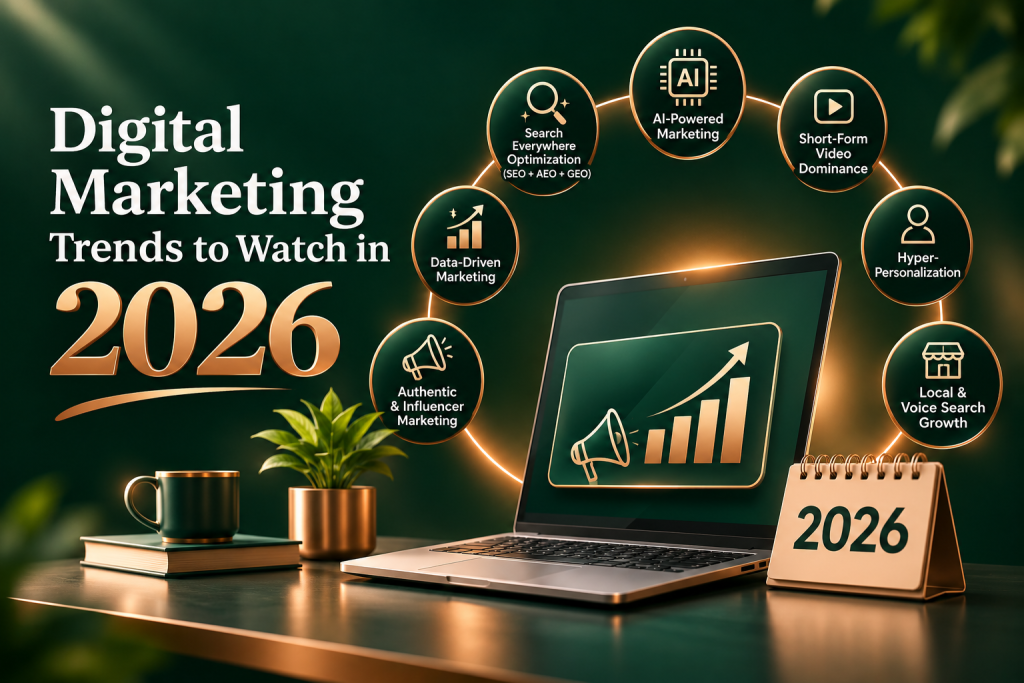
DIGITAL MARKETING TRANDS TO WATCH IN 2026

Digital Marketing Trends to Watch in 2026 Digital marketing is constantly evolving.What proved effective for businesses in the past may not yield the same results today.Consumers are spending more time online, search behaviors are shifting, and emerging technologies are offering companies new ways to engage with their audience. For businesses, this ongoing change brings both opportunities and challenges.There’s always a new platform, tool, or marketing approach to explore.However, this doesn’t mean every emerging trend should be adopted. The key is to understand what’s changing and determine which trends are relevant and beneficial for your specific business. If you’re developing your digital marketing plan for 2026, here are ten significant trends you should keep in mind. AI Is Changing the Way Businesses Do Marketing Artificial intelligence has quickly become a part of everyday marketing.Businesses are using AI to come up with content ideas, understand customer behavior, analyze data, writeinitial drafts, automate repetitive tasks, and improve customer support.But there is one important thing to remember: AI should be treated as a tool, not as a replacement forhuman thinking.People still want content that feels genuine. A completely automated marketing campaign can easily soundrepetitive or impersonal. Businesses can use AI to save time while keeping human creativity and strategyinvolved. SEO Is Becoming More About Helpful Content You do not have to look very far to see how popular short videos have become.Instagram Reels, YouTube Shorts, and other short-form video platforms have changed the way peopleconsume content. Users often decide within a few seconds whether they want to keep watching.For businesses, this creates a great opportunity.You can use short videos to show your products, explain services, answer common questions, share quicktips, introduce your team, or show what happens behind the scenes.The video does not always need to look like a professional advertisement. In many cases, simple andauthentic content can feel more trustworthy. Personalization Will Become More Important Customers are tired of seeing the same generic message everywhere.Personalization allows businesses to make their marketing more relevant to individual customers.For example, an online store might recommend products based on previous browsing behavior. An emailcampaign might send different messages to people depending on their interests.Even small changes can make a difference. Using relevant offers, useful recommendations, and audiencespecific content can make customers feel that a business actually understands them. Social Media Is Moving Beyond Follower Counts Having a large number of followers can look impressive, but followers alone do not guarantee businessgrowth.What matters is whether people are actually interested in what you are sharing.In 2026, businesses should focus more on building genuine relationships with their audience. Respondingto comments, asking questions, sharing useful information, creating polls, and encouraging customers toshare their experiences can help create a stronger community.Social media works better when it feels like a conversation rather than a constant sales pitch.. Voice and Conversational Search Are Growing The way people search online continues to change.Instead of typing a few words into a search engine, people are increasingly comfortable asking completequestions using natural language. Data Will Play a Bigger Role in Marketing Decisions Good marketing is not just about creativity.Website traffic, engagement, leads, conversions, advertising results, and customer behavior can providevaluable information.For example, suppose an advertisement is getting plenty of clicks but very few enquiries. Instead ofimmediately spending more money on the campaign, a business can look at the landing page andcustomer journey to understand where people are dropping off.Using data in this way can help businesses make more informed decisions and avoid wasting theirmarketing budget. Privacy and First-Party Data Matter More Customers are becoming more aware of how companies collect and use their personal information.Because of this, businesses need to be more careful and transparent with customer data.First-party data—information that customers willingly provide directly to a business—can becomeparticularly valuable.This can include information collected through website forms, newsletters, customer accounts, surveys, ordirect interactions.Building trust should be part of the marketing strategy, not something businesses think about later. Creator and Influencer Marketing Is Evolving Influencer marketing is no longer only about celebrities with huge follower counts.Smaller creators can have highly engaged audiences that are closely connected to a particular niche, city,industry, or interest.For businesses, this can create opportunities to reach a more specific audience.The important question is not simply how many followers a creator has. Businesses should also considerwhether the creator’s audience matches their target customers and whether the content feels authentic.A good partnership should make sense for both the brand and the creator’s audience. Websites Will Focus More on User Experience and Conversions Your website is often the first serious interaction a potential customer has with your business.If the website is slow, confusing, difficult to use on mobile, or unclear about what the business offers,visitors may simply leave.A modern business website should make things easy.Visitors should quickly understand:What your business doesWhat products or services you offerWhy they should choose youHow they can contact youWhat they should do next What Do These Trends Mean for Businesses The biggest lesson from these trends is that digital marketing is becoming more customer-focused.Technology is changing quickly, but the basic idea of good marketing has not changed: understand youraudience, provide something useful, communicate clearly, and build trust.You also do not need to start using every trend immediately.If SEO is already bringing traffic to your website, you may want to improve your content first. If youraudience spends most of its time on social media, short-form video may deserve more attention. If you arerunning paid campaigns, data and conversion optimization may be more important. How a Digital Marketing Agency Can Help Keeping track of SEO, social media, paid advertising, content, analytics, websites, and new technology canbe difficult when you are also trying to run your business.A digital marketing agency can help you bring these different pieces together.From improving your website and search visibility to creating content, managing social media, and runningpaid campaigns, the right marketing strategy can help your business build a stronger online presence.The focus should not simply be on getting more clicks or followers. The goal is to turn online attention intomeaningful

Scroll to Top