
What is Search Everywhere Optimization
For decades, the playbook for growing a business online was remarkably simple: if someone wanted to buy a product, hire a service, or learn something new, they “Googled it.” Your entire digital footprint depended on ranking in those ten blue links on a Google Search results page.
But a massive shift in user behaviour has quietly turned the internet upside down. Today, younger generations don’t just default to a traditional search engine. If they want to find a trendy restaurant, they search on Instagram Reels or TikTok. If they want unbiased product reviews, they append “Reddit” to their query or search directly within Reddit communities. If they need a complex coding or business problem solved, they ask OpenAI ChatGPT or Perplexity AI.
Because consumers are searching across multiple platforms, traditional SEO has evolved into Search Everywhere Optimization (SEO 2.0).
If you are a business owner, founder, or marketer, this in-depth guide is your survival manual for the future of search. We will break down exactly how SEO 2.0 works and how you can optimize your brand across every platform where your customers are actively looking for you.
What Exactly is Search Everywhere Optimization (SEO 2.0)?
Search Everywhere Optimization is an omnichannel marketing strategy focused on making your brand visible in the search bars of all major digital platforms, not just traditional search engines.
Instead of treating social media platforms purely as entertainment networks and search engines as informational tools, SEO 2.0 treats every single platform with a search bar as a search engine.
The transition from traditional SEO to SEO 2.0 is a complete change in strategy:
• Traditional SEO: Focuses
primarily on text-based web pages, backlinks, technical site speed, and domain authority to rank on Google or Bing.
• Search Everywhere Optimization: Focuses on multi-modal content (short-form video, images, interactive text, AI answers) tailored to the unique in-app search algorithms of social media, e-commerce, and artificial intelligence platforms.
Why Consumer Search Behaviour Has Changed
Google remains a powerful tool, but its absolute monopoly on user attention is declining. Understanding why users are exploring alternative platforms is key to mastering SEO 2.0:
Text descriptions can only go so far. If a user is looking for a “minimalist living room design” or a “travel itinerary for Tokyo,” they want to see it visually. Platforms like Pinterest and TikTok allow users to experience the answer through high-definition photos and authentic short-form videos rather than reading through a 3,000 -word blog post.
Traditional search results are frequently crowded with heavily optimized corporate blogs, sponsored advertisements, and affiliate websites. When modern consumers want an honest, unvarnished opinion on the “best CRM software” or “most reliable running shoes,” they trust peer discussions on Reddit or real-time recommendations from creators on Instagram.
People want answers instantly without filtering through dozens of cookie-cutter websites. Generative AI tools synthesize information from across the web and present a highly tailored, direct response in seconds. This has led to the rise of Answer Engine Optimization (AEO)
How to Optimize Your Brand Across Every Platform
To build a successful Search Everywhere strategy, you must adapt your content to match the search mechanics of each specific digital ecosystem:
Social media platforms use advanced natural language processing (NLP) to index video content. To rank your Reels and TikToks in app searches:
• Say Your Keywords Aloud: The built-in AI auto-transcribes your audio. Explicitly stating your target keywords in the video improves discoverability.
• Use On-Screen Text Hooks: Place your primary keyword as text on the screen within the first 3 seconds of your video.
• Optimize Captions and Bios: Treat your social media profile bios and post captions like a meta description. Integrate primary search terms naturally instead of just stuffing dozens of hashtags at the bottom.
AI platforms pull information from structured, authoritative web data. To ensure platforms like ChatGPT, Claude, and Google Gemini recommend your business:
• Utilize Schema Markup: Implement advanced structured data on your website so AI web crawlers can seamlessly index your pricing, services, and corporate entities.
• Build Digital PR Footprints: AI models lean heavily on brand mentions across major news outlets, industry journals, and PR platforms to verify your authority.
Community search relies on reputation, upvotes, and real-world relevance:
• Provide Transparent, Non-Salesy Value: Join relevant subreddits related to your industry. Answer user problems thoroughly without dropping aggressive sales pitches, which will get you downvoted or banned.
• Build Keyword-Rich Educational Threads: Write detailed, high-value guide threads within communities. These threads often rank exceptionally well not just inside the app, but also on traditional Google search results.
As the world’s second-largest search engine, YouTube requires a deliberate optimization approach:
• Keyword-Driven Title & Descriptive Tags: Ensure your primary search term is at the front of your video title.
• Leverage Video Chapters: Divide your video into logical, time-stamped chapters. Search engines often extract these chapters to display them directly as rich snippets on web search results.
• Write Deep Descriptions: Spend time writing a 200-to-300-word summary in your video description box, incorporating primary and secondary keywords.
The 4-Step Search Everywhere Implementation Blueprint
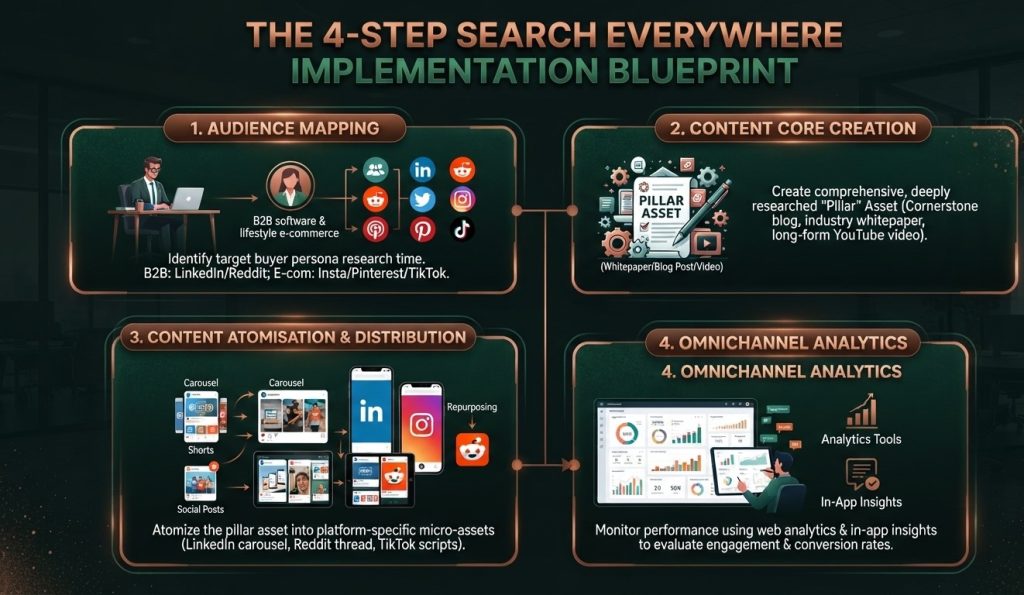
Deploying an SEO 2.0 strategy does not mean you need to write entirely new content for every platform from scratch. Instead, follow this centralized workflow:
1. Audience Mapping: Identify where your target buyer persona spends their research time. B2B software buyers heavily utilize LinkedIn and Reddit, while lifestyle e- commerce buyers congregate on Instagram, Pinterest, and TikTok.
2. Content Core Creation: Start by creating one comprehensive, deeply researched “pillar” asset, such as a cornerstone blog post, an industry whitepaper, or a long- form YouTube video.
3. Omnichannel Analytics: Monitor performance using a combination of web analytics tools and native in-app insights dashboards to evaluate which platform drives the highest engagement and customer conversion rates.
4. Content Atomisation and Distribution: Atomize the pillar into platforms specfitic micro assests
Conclusion: Future-Proofing Your Digital Visibility
The internet is becoming increasingly decentralized. Relying solely on a single traffic source leaves your business vulnerable to algorithmic updates and shifting user trends. By embracing Search Everywhere Optimization, you transform your brand from a single website hidden in a web index into an omnipresent authority that appears wherever your next customer decides to look.
Frequently Asked Questions

Not at all. Google still processes billions of searches every single day and remains a massive source of traffic. However, traditional SEO is no longer sufficient on its own. SEO 2.0 expands upon traditional methods to capture the millions of searches happening outside of Google’s ecosystem
Traditional keyword tools like Google Keyword Planner don’t capture social media search volumes perfectly. Instead, use the native search bars within those apps. Type in your industry topic and analyze the auto-suggested phrases that pop up underneath—those represent real, high-volume searches being conducted by users in real-time
Purely copied, low-effort AI content often lacks unique value and fails to rank well because search engines look for real human experience and authority. You can absolutely use AI tools to help brainstorm frameworks or speed up the formatting process, but always inject your brand’s unique case studies, data, and human tone of voice before publishing.