
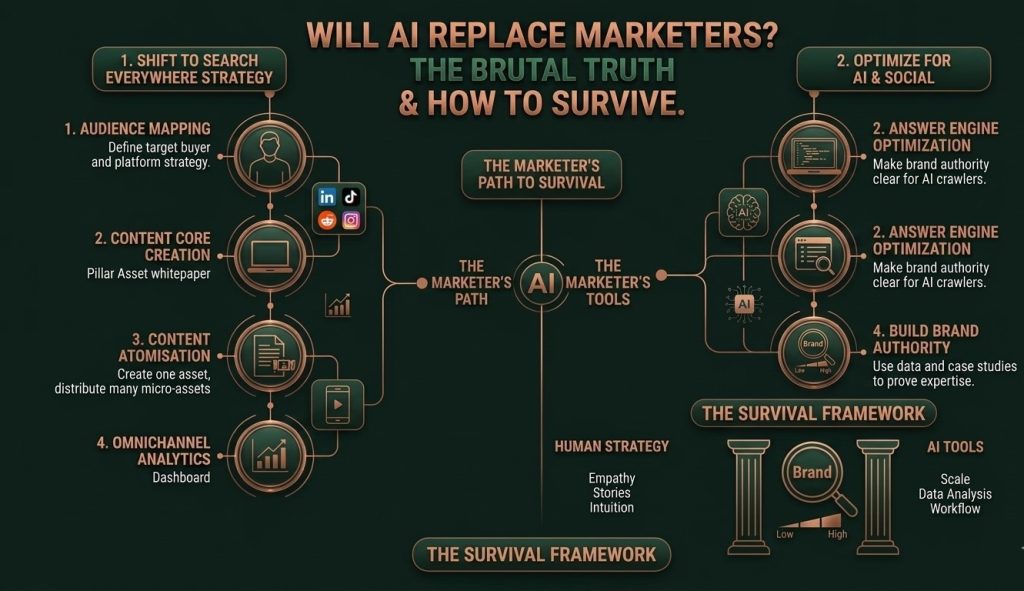
Will AI Replace Marketers? The Brutal Truth & How to Survive.
Let’s be completely honest for a second.Over the last year or two, tech has moved so fast it’s given almost every digital marketer a bit of whiplash. When ChatGPT first dropped, it was a fun novelty. Now? You watch tools like Gemini, Jasper, and Midjourney pump out full-length articles, social media calendars, and gorgeous graphics in about four seconds flat.If you are a content writer, SEO specialist, or social media manager, it is completely normal if your stomach drops a little when you see that. It’s hard not to look at a machine doing your eight-hour workday in the blink of an eye and wonder: “Am I about to be obsolete? Let’s cut through the tech-bro hype, look at the reality on the ground, and talk about what it actually takes to stay irreplaceable.
Where AI is Genuinely Crushing It
We shouldn’t try to downplay what AI can do. If we pretend it’s just a passing fad, we lose. The reality is that generative and predictive AI are radically shifting how marketing departments run because machines are just flat-out better at certain things than our human brains.
Remember the days of staring at Google Analytics for hours, trying to figure out why a specific audience segment stopped buying? AI does that instantly now. It sifts through millions of rows of data, spots the pattern, and can practically tell you what your audience wants to buy before they even know they want to buy it.
If a company needs 20 variations of an ad copy for a Facebook campaign, a human copywriter is going to need a few hours, a quiet room, and probably three cups of coffee. An AI model can give you 50 variations before you finish typing the prompt. For high-volume, basic execution, humans can’t compete on speed.
Think about your Netflix home screen or your Spotify Discovery Weekly playlist. It’s completely unique to you. AI tracks every single click, skip, and pause to curate a hyper-personalized world. Doing that at scale for millions of users manually is completely impossible.
Where AI Fails Miserably (The Human Advantage)
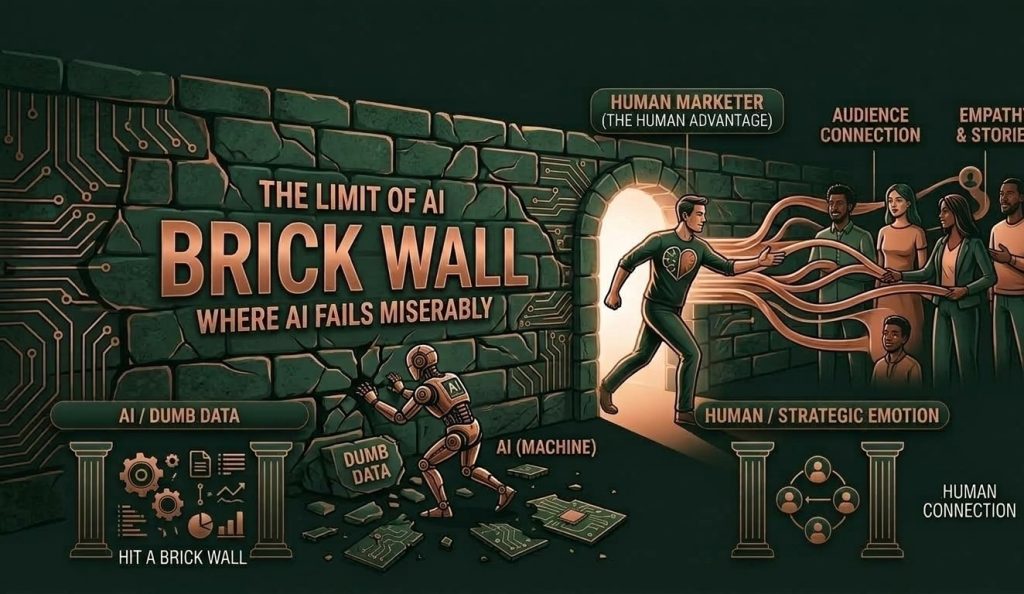
Here is the turning point in the story. AI is incredibly smart, but it is also profoundly dumb in ways that matter most to marketing. Marketing isn’t just data engineering; it’s human connection. And that is exactly where machines hit a brick wall.
AI is like a super-genius assistant that is also incredibly literal. If you give it a lazy, generic prompt, it will give you a lazy, generic output. Learn how to write deep, context-rich prompts. If you are the person who knows how to make the AI produce brilliant results, you become invaluable to any company.
When you write an article, an email, or a script, stop trying to sound academic or clinical. Inject you into it. Share that time you messed up a client’s budget. Talk about a weird conversation you had at a coffee shop. Share actual case studies with raw, messy data. Audiences are developing an incredibly sharp radar for AI- generated text, and original human experience is the highest-value currency on the internet right now.
AI can write a caption, but it can’t build a brand’s identity from scratch. It can’t look at a struggling startup, understand the founder’s vision, and figure out how to position them to disrupt a legacy industry. Move your focus away from the button-clicking execution and move it toward psychology, positioning, and long-term strategy.
Conclusion: Your Co-Pilot, Not Your Replacement
Every time a major technology enters the workforce, panic follows. When the camera was invented, painters thought art was dead. When computers entered the workplace, people thought offices would empty out. Instead, those tools just raised the baseline of what humans could achieve.
AI isn’t the pilot of your marketing career—it’s your co-pilot. It is here to take the boring, exhausting, repetitive tasks off your plate so that you can actually spend your day doing the things human brains were built for: thinking creatively, building relationships, telling great stories, and connecting with people.
Stop worrying about the machine taking your desk. Master the machine, put it to work for you, and build something incredible.
Frequently Asked Questions

No, but the job description is changing. Instead of hiring an intern to spend ten hours writing basic SEO descriptions, agencies will hire an intern who can use AI to do that in thirty minutes, and then spend the rest of the day analyzing the conversion data or researching competitors.
Break the rules of formal grammar occasionally. Use shorter sentences. Inject humor, rhetorical questions, and personal opinions. AI text is incredibly predictable and balanced; human writing is conversational, rhythmic, and sometimes a little messy.
If you want to get good at prompting and research, use ChatGPT or Claude. For visual brainstorming, dive into Midjourney or the AI features inside Canva. For SEO and sorting through massive amounts of search data, Semrush is still the gold standard.
It can understand the data of human psychology (e.g., “70% of people click this specific headline format”). But it doesn’t understand the lived reality of human emotion. It cannot replicate the cultural trends, organic shifts in taste, and emotional triggers that happen in the real world.