
Zero-Click Searches in 2026: The Ultimate SEO Survival Guide
Let’s be completely honest: the old school SEO playbook is dead and buried.
For over twenty years, the formula for winning online was incredibly predictable. You found a few high-volume keywords, wrote a comprehensive blog post, optimized the title tags, and waited for Google to rank you on page one. Once you hit that top spot, a steady stream of organic website traffic followed naturally, filling your sales funnel with fresh leads.
Fast forward to 2026, and that linear path is completely broken. Welcome to the era of the Zero-Click Search.
Recent data from top clickstream providers and enterprise marketing platforms confirms a brutal reality: more than 68% of Google searches now end without a single click to an external website. Instead of acting as a traditional digital highway that directs users to independent blogs, e-commerce stores, or service pages, Google has evolved into a closed-loop answer engine. Users get the exact information they want right on the results page, leaving without ever stepping foot on your website.
For business owners, startup founders, and digital marketing agencies, this feels like an absolute emergency. You can invest months of sweat equity and hard cash into securing a top spot, only to watch your organic click-through rates (CTR) nosedive.
But here is the real kicker: buyers haven’t stopped searching. Google has just changed where they consume your information. If you know how to adapt, you can turn this shift into an incredible branding and lead-generation opportunity. In this definitive guide, we will break down the mechanics of zero-click searches, look at the tech behind them, and give you an actionable playbook to win the game of invisible traffic.
The Anatomy of a Zero-Click Search: What Does the SERP Actually Look Like?
To win a game, you have to understand how the board is set up. A zero-click search happens when a user types a question into a search bar, reads the answer directly on the screen, and closes the tab or searches for something else entirely. No links clicked, no website visits recorded.
Google’s search results page isn’t just a simple list of ten blue links anymore. It is an interactive, AI-driven dashboard designed to keep users on Google for as long as possible. Here are the main features keeping your traffic trapped on the SERP:
Powered by advanced language models and Retrieval-Augmented Generation (RAG), AI Overviews sit right at the top of the page. They scrape data from multiple web pages simultaneously and blend them into a single, conversational answer. Because the AI answers the user’s question perfectly right out of the gate, queries that trigger an AI Overview suffer an average 83% drop in traditional organic clicks.
Whether it’s a bulleted list of steps, a quick definition, or a product pricing table, Google takes the best answer from a high-ranking page and highlights it in bold text at the top of the screen. The user gets the value in five seconds flat, meaning they have zero reason to click through to your article
If someone searches for a well-known entity—like a public company, a famous person, a local business, or a historical fact—Google displays a dense sidebar packed with data, stock tickers, and social profiles. This data is pulled from structured open-source databases, completely wiping out informational traffic for those terms.
For local searches (like “emergency plumber near me” or “best coffee shop open now”), Google pulls up an interactive map embedded with reviews, phone numbers, photos, and direct booking buttons. The entire evaluation and buying process happens without the user ever opening a business’s actual website.
The Hard Numbers: Breaking Down Changing Consumer Behavior
If your marketing team is still measuring SEO success by looking blindly at raw organic impressions or keyword ranking spreadsheets, you are chasing vanity metrics. The real numbers paint a completely different picture of how people use the internet today:
• The Big Picture: For every 1,000 desktop searches on modern engines, fewer than 340 end up clicking on an independent website. On mobile, that number drops even lower—fewer than 230 clicks, which means a 77% mobile zero-click rate.
• Informational Content is Losing the Volume Game: Basic educational terms, simple definitions, and quick how-to questions have seen a massive 48% drop in click volume over recent algorithm updates.
• Traffic Quality is Skyrocketing: Here is the silver lining: even though raw informational traffic is down, the users who do actually click through to deep pages have incredibly high commercial intent. They are looking for deep-dive case studies, downloadable templates, or actual purchasing options that a quick AI summary simply can’t provide.
The strategic takeaway? Traffic volume is shrinking, but traffic value is accelerating. Your job isn’t to chase mass casual eyeballs anymore—it’s about dominating authoritative visibility.heading.
Generative Engine Optimization (SEO vs. GEO)
As search engines shift toward conversational AI interfaces, standard keyword optimization is giving way to a new marketing discipline: Generative Engine Optimization (GEO). If you want your business to stay visible, you need to format your website content so AI crawlers select your paragraphs as the foundational sources for their AI summaries To ensure your brand lands front and center inside AI-generated summaries, integrate these advanced formatting updates into your content workflow: As search engines shift toward conversational AI interfaces, standard keyword optimization is giving way to a new marketing discipline: Generative Engine Optimization (GEO). If you want your business to stay visible, you need to format your website content so AI crawlers select your paragraphs as the foundational sources for their AI summaries To ensure your brand lands front and center inside AI-generated summaries, integrate these advanced formatting updates into your content workflow:
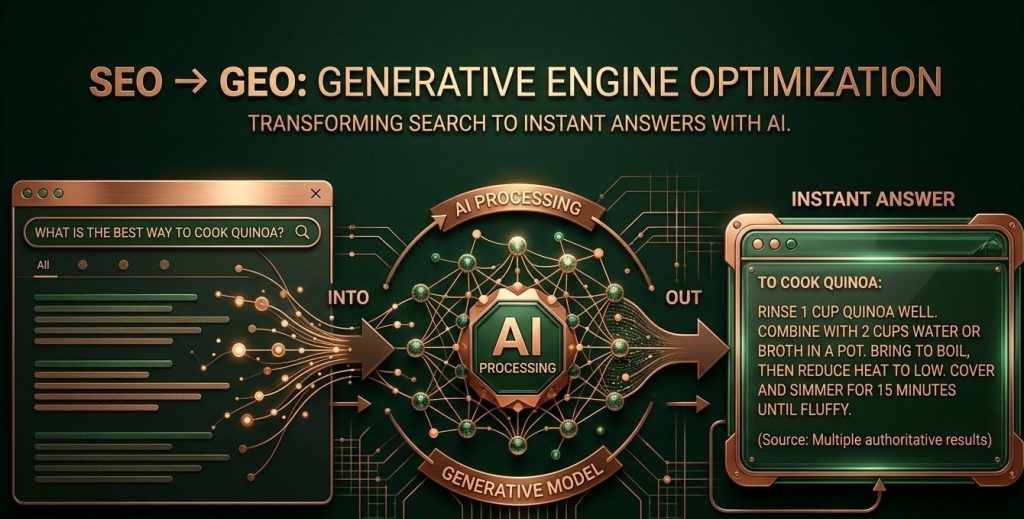
AI scrapers value speed and extreme clarity. Start every sub-section of your blog with a direct, crystal-clear statement that answers the core question within the first 45 words. Once you’ve delivered that dense nugget of information, use the rest of the section to provide deeper context, technical details, and data. This allows an AI model to easily extract your core points while attributing the source link back to your domain.
Modern search engines don’t look at keywords in isolation; they look at “entities” (real-world concepts, businesses, items, and people) and how they connect. Don’t just repeat a keyword; use precise industry terminology, reference trusted case studies, and clearly explain how your services connect to established industry standards.
Make sure your development team is setting up meticulous structured data protocols. Use Product Schema, Organization Schema, FAQ Schema, and Article Schema. Think of this clean code as a direct translator that allows search bots to instantly read your pricing, author credentials, and service areas without having to guess.
How to Steal Featured Snippets and PAA (People Also Ask) Boxes
Securing a spot inside featured snippets and People Also Ask (PAA) drop-down menus is like getting a VIP pass to the top of Google. Even if a user decides not to click, your brand name gets massive, unmissable exposure that builds instant trust
sub heading:- Real Tactics to Win Snippets
• Clean Up Your HTML Lists: When you write a tutorial or step-by-step guide, format the core execution steps using clean, logical HTML ordered lists () or unordered lists (). Keep each bullet point short, punchy, and action-oriented.
• Build Responsive Data Tables: Search engines love tables when comparing things (like “Software A vs Software B cost”). Create actual HTML tables inside your blog posts instead of uploading an image of a chart. Search bots can easily scrape text from a table, but they can’t read data trapped inside a JPEG or PNG file.
• The “Define-and-Conquer” Technique: Use clear or subheadings structured as direct questions (e.g., “What is the definition of X?”). Follow that heading immediately with a definitive block of text wrapped in a paragraph tag (), keeping the tone completely objective, factual, and direct
Local Search Dominance: Turning Impressions Into Revenue
For local businesses—like dental practices, law firms, roofing companies, and local agencies—zero-click behavior is actually a massive win, not a threat. Look at it this way: if a customer finds your phone number, reads your reviews, and books an appointment without ever looking at your website, your online presence To turn local map impressions into paying customers without relying on standard website visits, run through this checklist:has done its job perfectly.
Your GBP is the face of your business on Google maps. Make sure your business categories are 100% accurate, upload high-quality photos of your team and completed jobs every single week, and ensure your Name, Address, and Phone Number (NAP) are identical across every directory on the web.
Boost Your Review Velocity and Depth
The local map algorithm heavily favors businesses that show consistent review growth. Set up automated text messages or emails to ask your clients for 5-star feedback right after a job is done. Don’t just ask for stars—encourage them to mention the specific service they purchased (e.g., “AC repair” or “logo design”) to strengthen your local SEO keywords
sub heading:- Turn on Native Booking and Messaging Features
Remove all friction between you and a prospect. Turn on the direct messaging features inside your Google profile, enable quick quotes, and link your backend booking calendar with Google’s official scheduling tools so clients can lock in consultations without leaving the search screen.
Audience Diversification: Building a Future-Proof Marketing Engine
The biggest mistake you can make right now is putting all your marketing eggs in one algorithmic basket. If a search engine rolls out a massive update tomorrow and you rely entirely on informational search clicks, your lead pipeline could dry up overnight. Future-proofing your business means building an “owned audience.”
Every single person who lands on your site is a golden opportunity to build a direct connection. Use highly targeted lead magnets, proprietary industry reports, free interactive calculators, or exclusive video guides to convert anonymous web browsers into verified email and SMS subscribers.
Modern consumers want real human interaction, not robotic marketing emails. Build active, engaged communities on platforms your audience already uses, like curated WhatsApp Enterprise channels, private Discord servers, or custom Slack groups. This gives you a direct line to share updates, launch deals, and drive repeat business without worrying about algorithm shifts.
The absolute best defense against a zero-click search engine is to make your brand so famous that people look for you by name. Invest in high-value podcast appearances, digital PR campaigns, and thought leadership articles on LinkedIn. When a buyer types your exact company name into the search bar, you own the entire screen, completely bypassing the messy zero-click landscape.
Frequently Asked Questions

Yes, AI-generated content can absolutely rank. Google’s core systems focus heavily on the accuracy, utility, and overall value of a page, regardless of the tools used to create it. However, copy-pasting raw, generic AI drafts onto your blog will not work. To win featured snippets and earn AI Overview citations, you must enrich your content with unique first-party data, real-world case studies, and deep human perspective that software models can’t replicate.
Not even close. SEO isn’t dying; it’s growing up. While simple informational queries are resulting in fewer website clicks, complex search intents—like in-depth software comparisons, step-by-step technical guides, and commercial purchase paths—still drive massive web traffic. The discipline is shifting from mass traffic collection to high-value thought leadership placement
If you only look at standard Google Analytics sessions in a zero-click world, you’re missing the whole story. You need to adjust your KPIs to track Answer Inclusion Rates (how often AI search engines cite your brand name), Branded Search Lift (the number of people searching for your company name directly), and total Visual Impressions in Google Search Console. At the end of the day, your bottom-line lead volume and conversion rates matter most.
Yes, but your goal needs to change. Don’t target basic informational keywords expecting to get a ton of clicks to a blog post. Target them to capture the dominant top-of-page real estate held by snippets and AI boxes. When thousands of potential customers constantly see your company cited as the definitive source in Google’s AI summaries, it builds immense brand trust that pays off heavily when they enter the buying phase.
If your website isn’t optimized for structured data, AI engines, and local map widgets, your brand will effectively become invisible on the modern web. Competitors who update their websites for data extraction will capture the entire share of top-of-funnel customer impressions, leaving you completely out of the loop