
10 Common PPC Advertising Mistakes
Hidden Holes in Your Budget: Common PPC Advertising Mistakes and How to Fix Them
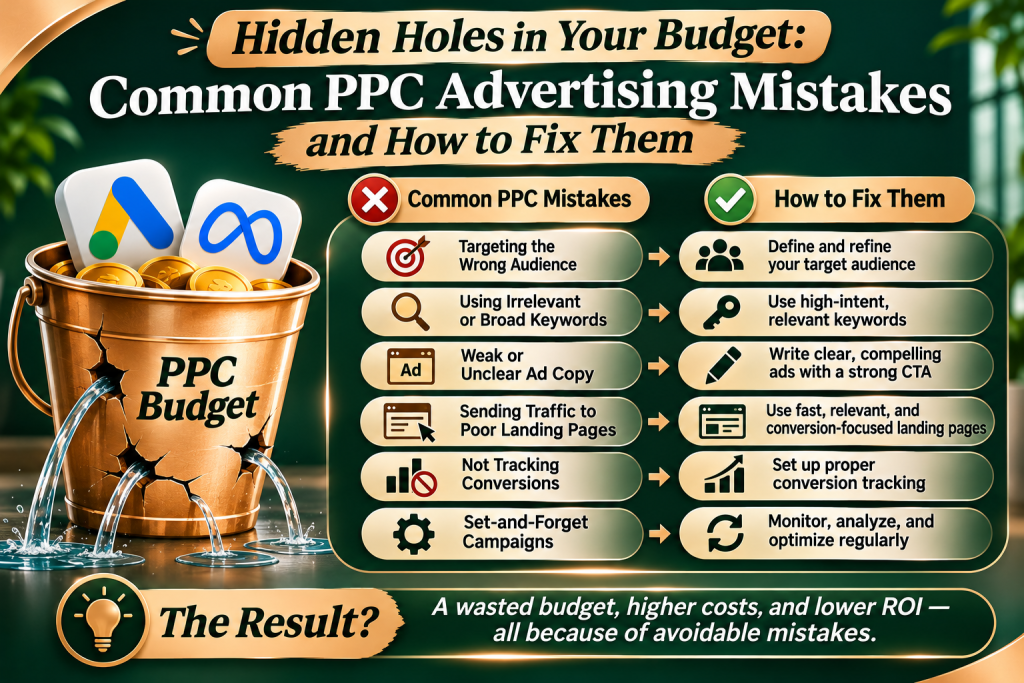
When Pay-Per-Click (PPC) advertising works, it feels like an absolute superpower. You put a dollar into the machine, target the exact human being who needs your service, and get two dollars back. It is fast, highly trackable, and can scale a business almost overnight.
But when it doesn’t work? PPC feels like throwing your hard-earned money straight into a roaring campfire.
The honest truth about online advertising is that platforms like Google Ads and Meta Ads are intentionally designed to make it incredibly easy to spend money, but significantly harder to turn a profit. If you just set up a campaign, walk away, and hope for the best, you are likely burning through your marketing budget without even realizing it.
Whether you are a small business owner running your own ads or an experienced marketer cleaning up an old account, spotting these structural errors is the fastest way to save your budget. Let’s dive into the most common PPC blunders that quietly drain your bank account and look at how to easily fix them.
One of the biggest myths in digital marketing is that PPC campaigns are automated money machines. People think you can just write a couple of headlines, put in a credit card, and let the system run forever.
This is a surefire way to lose money. Ad networks tweak their algorithms constantly, new competitors enter your bidding auctions daily, and customer search habits change with the seasons.
If you don’t check your dashboard regularly, a tiny shift in the market can quickly tank your results. Managing a successful ad account requires consistent love—checking search queries, testing fresh visuals, and pausing ads that just aren’t pulling their weight.
For businesses running Google search campaigns, keyword match types tell the system exactly what phrases should trigger your ads. By default, Google pushes you hard to use Broad Match.
While Broad Match gets you the most views, it also gives the algorithm total freedom to display your ad for anything it thinks is loosely related to your business.
• The Problem: If you own a high-end boutique hotel and bid on the broad phrase “luxury hotel,” Google might display your ad to someone searching for “cheap motel rooms,” “hotel construction jobs,” or “luxury hotel wallpapers.”
• The Result: You end up paying for expensive clicks from people who have zero intention of booking a stay with you.
The Quick Fix
Switch your strategy toward Phrase Match (using quotation marks like “luxury hotel”) or Exact Match (using brackets like [luxury hotel]). This forces the ad network to show your link only when a user’s search intent actually matches what you sell.
Think of negative keywords as a giant digital shield for your wallet. They tell the advertising platform exactly which words and phrases you want to completely block from triggering your ad.
Failing to build out a strong negative keyword list is easily one of the most expensive mistakes you can make. If you don’t tell the platform what you don’t want, you will end up paying for a lot of completely useless web traffic.
Imagine clicking an ad that promises a 30% discount on a specific pair of waterproof hiking boots. But instead of taking you to those boots, the link drops you right onto the store’s generic homepage. Now you have to click around, hunt through menus, and search the site just to find what you were looking at.
What do you do? You leave. You click the back button and try a competitor’s site.
Sending paid ad traffic to a broad homepage is a massive conversion killer. Your homepage is designed to give an overview of your entire company; it is not built to close a highly specific sale.
The Solution
Every single ad campaign you run needs a dedicated, hyper-focused Landing Page. If your ad promotes a specific plumbing repair service, the link must take the user to a page that talks only about that specific repair service, complete with a direct phone number and an easy quote form. The shorter the path from click to buy, the more money you make.
If you don’t have conversion tracking set up correctly, you are essentially driving down a dark highway with your headlights turned completely off. You might see clicks coming into your dashboard, but you have no idea which specific keyword or ad visual actually generated a phone call, form fill, or sale.
Without accurate tracking data, you are just guessing. You might accidentally turn off your highest-performing keyword because it looked expensive, while pouring more cash into an ad that brings in lots of cheap clicks but zero revenue.
Before you spend another dollar on live ads, double-check that your tracking pixels (like Google Tag Manager or the Meta Pixel) are firing perfectly on your “Thank You” or confirmation pages.
Many businesses write ads that read like a technical manual. They list their specifications, state their business hours, and list their certifications.
The problem? Your customers don’t care about your specifications; they care about solving their own problems.
Good ad copy focuses on benefits, emotions, and solutions. It should directly address the exact pain point your user is feeling at that moment and offer a clear path forward.
• Bad, Robotic Copy: “We do commercial roof repairs. Certified technicians available. 24/7 service. Call us today.”
• Good, Human Copy: “Leaky roof putting your inventory at risk? Get fast, reliable commercial repairs today before the next storm hits. Free inspections.”
WIt is easy to forget that people experience your ads differently depending on the screen they are holding. If you design your landing pages, ad text, and checkout steps exclusively on a massive desktop monitor, you might completely miss major bugs on mobile screens.
If your page takes five seconds to load on a smartphone, or if your signup form is impossible to type into with two thumbs, people will leave. Take a look at your data broken down by device type. If mobile traffic is underperforming, fix your mobile user interface immediately.
There is a huge ego trap in PPC advertising: wanting to see your business at the absolute top of Google for every major keyword in your industry.
Chasing the number one spot at all costs is a great way to blow through a budget just for a vanity metric. Bidding aggressively enough to secure the top spot often means paying an unsustainably high Cost Per Click (CPC).
Frequently, holding the 2nd or 3rd ad position yields a slightly lower click-through rate but offers a significantly cheaper CPC. This lower cost allows your daily budget to buy far more clicks overall, ultimately resulting in a much healthier bottom line and a better return on your ad spend.
Conclusion: Plug the Leaks and Optimize
PPC advertising isn’t about outspending your biggest competitors; it’s about outsmarting them. By simply fixing these setup errors—tightening your keyword match types, deploying negative keywords, routing traffic to dedicated landing pages, and keeping your conversion tracking pristine—you instantly gain a massive advantage over most advertisers.
Stop treating your ad accounts like a lottery ticket. Treat them like a laboratory: measure your results, cut away the waste, and double down on what actually makes you money.
Frequently Asked Questions

While your ads go live almost instantly, a brand-new campaign typically requires a 2-to-4-week “learning phase.” During this window, the ad platform’s algorithm tests your copy and visuals against different audiences to see what performs best. Avoid making drastic strategy pivots during this early period while the system gathers foundational data.
There is no universal minimum, but a good rule of thumb is to start with a budget that allows you to buy at least 20 to 30 clicks per day based on your industry’s average Cost Per Click. For most local service businesses, starting with $10 to $20 a day is plenty to collect clean performance data without overextending financially.
A high click-through rate (CTR) paired with low conversions usually points to a disconnect between your ad copy and your website experience. This means your ad is engaging enough to get people to click, but once they arrive on your landing page, they encounter slow load times, confusing messaging, hard-to-use forms, or unexpected pricing structures.
Yes, in almost all cases, bidding on your own branded terms is a smart protective move. Branded keywords are incredibly cheap to bid on, and running these campaigns ensures your competitors can’t easily buy ad space at the top of search results for your company name to steal away your warmest leads.