
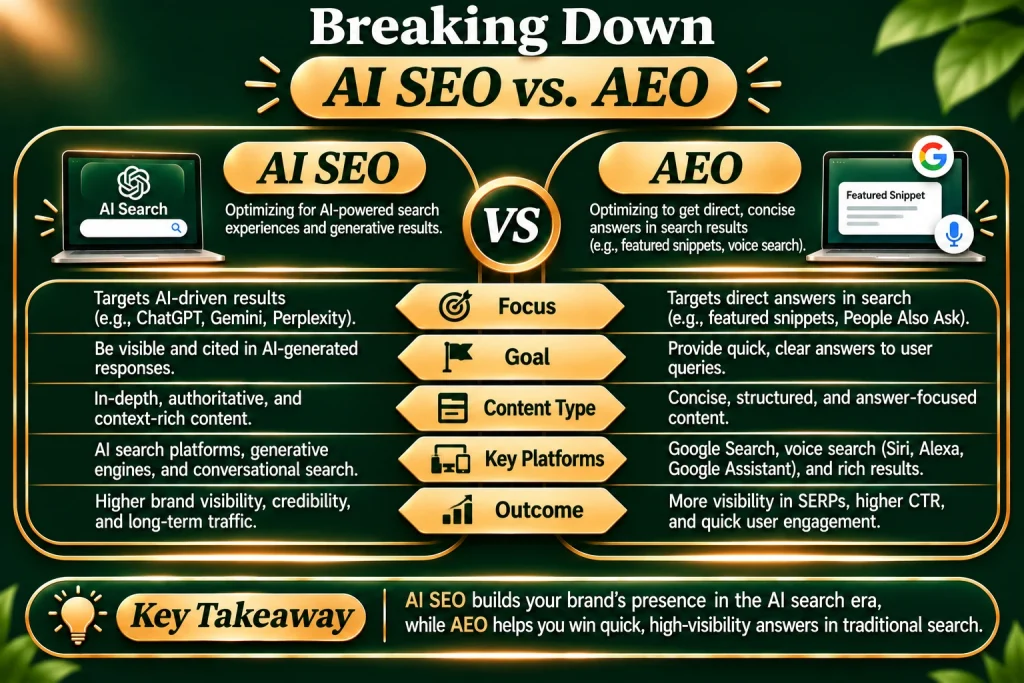
AI SEO & AEO
The Word-Matching Days (1998–2012) Aerly search engines were incredibly literal. If someone typed “best running shoes,” the algorithm simply looked for the page that repeated that exact phrase the most times. It was clunky, easy to game with keyword stuffing, and resulted in terrible user experiences The Intent Era (2013–2022) Google got smarter with updates like RankBrain and BERT. Search shifted from matching literal words to understanding human intent. Google built its Knowledge Graph to understand how real-world entities (people, places, and brands) connect. It started answering what you meant, not just what you typed. The Generative Answer Era (2023–Present) Today, search is fully cognitive. Generative engines don’t just hand over a list of websites; they read the web in real-time, mix data from multiple sources on the fly, and write a custom paragraph specifically for the user. Breaking Down AI SEO vs. AEO While both strategies aim to get your brand noticed, they require very different approaches behind the scenes. Think of AI SEO as optimizing your entire house for modern visitors, while AEO is making sure the front door is completely wide open for AI delivery bots. he Zero-Click Reality Over 60% of searches now result in zero clicks because search and answer engines solve the query instantly on-page. This means traffic volume metrics will naturally shift. Instead of chasing millions of low-intent clicks, AEO targets hyper-specific, high-intent leads who read your brand’s name cited as the absolute authority inside an AI window. Making Your Site Easy for AI Bots to Crawl If an AI chatbot’s scraper hits a wall on your site, your content cannot be read. Let’s fix the technical issues that keep your site hidden from large language models. Give the Bots Permission Some website owners block AI scrapers completely out of fear. But if you want free traffic from tools like SearchGPT or Perplexity, you need to invite their crawlers in. Check your robots.txt file and make sure you are not accidentally blocking these critical search agents: Ditch the Heavy JavaScript Delays AI bots are built for speed. If your most valuable information, pricing numbers, or core answers are locked behind complex, slow-loading JavaScript, the bot will get tired of waiting and move on to a competitor’s page. Use Server-Side Rendering (SSR) to serve clean, static HTML that bots can read instantly. Translate Your Data with Schema Markup Schema markup is basically an explicit cheat-sheet for artificial intelligence. By adding simple JSON-LD code blocks to your pages, you tell the machine exactly what your data represents. Focus heavily on three core types:• Product Schema: Delivers clear prices, availability statuses, and physical specifications.• FAQ Schema: Creates direct question-to-answer matching pathways for quick generation summaries.• Organization Schema: Proves your business is real, localized, and verified across official channels Proving Your Real-World Credibility (E-E-A-T) AI engines are deeply terrified of one thing: hallucinating or sharing fake news. Because of this, their algorithms are aggressively tuned to look for real human authority. Google calls this E-E-A-T (Experience, Expertise, Authoritativeness, Trustworthiness). Share True, First-Hand Experience An AI model can summarize a textbook, but it cannot unbox a physical product, walk into a retail shop, or spend three hours troubleshooting code. Lean into what makes you human by updating your sentence styling:• Use phrases that show ownership: “During our internal product testing, our team discovered a bug when…”• Include original, real-world photos and videos of you or your team actually doing the work rather than stock imagery. Clean Up Your Digital Footprint AI tools look at the entire internet to figure out who you are. Make sure every article on your site has a real author bio linked to an active LinkedIn profile or personal portfolio. Get your team featured on podcasts, write guest columns for reputable trade sites, and participate in community forums like Reddit. The more the web connects your name to a specific topic, the more AI tools will trust your content. Writing for the Machines — The Rules of GEO If you want to drive traffic to your website today, you have to write for a dual audience. You are no longer just writing for a human reader sitting at a desk; you are writing for the Large Language Model (LLM) that reads your website and decides whether or not to recommend you. This shift has created a brand new copywriting style called Generative Engine Optimization (GEO).GEO is not about gaming an algorithm or over-complicating your sentences. It is about structuring your text so clearly that an AI model can parse your data, trust your assertions, and present your brand as the perfect solution. The Inverted Pyramid Writing Framework To get cited by tools like ChatGPT or Google AI Overviews, you must structure your content like an inverted pyramid. Put your summary at the absolute top, followed by structural explanations, and conclude with deep-dive contextual details. The 3-Part Content Block Strategy: 1. The Question Subheading: Make your H2 or H3 tags read exactly like a natural question a human would say out loud to an assistant.2. The Instant Snippet: Put a clear, direct answer in the very first sentence right under that heading. Keep it between 40 to 60 words and cut any introductory filler words.3. The Proof Layer: Immediately back up that quick answer with a bulleted list, a comparison table, or a specific qualitative data point. The 4 Types of Conversational Intent You Need to Cover When designing your content topics, ensure you create specific pieces that map to these four distinct conversational pathways: Definitional Intent (“What is…”) Users seek a crisp, clear baseline breakdown of a concept. Provide clean, definitive blocks of text without unnecessary storytelling. Comparative Intent (“X vs Y”) Users want an honest breakdown comparing options. Build comprehensive comparison tables that weigh real pros, cons, prices, and software limitations. Diagnostic Intent (“How to fix…”) Users describe a problem and expect a fix. Create numbered, step-by-step troubleshooting guides that outline an exact, actionable path forward. Attribution Intent (“Best near me”) Users